

objectiF RPM – Your Central ALM Tool for the Entire Software Lifecycle
Increasing system complexity, distributed teams, and growing demands require a secure, scalable, integrated setting that can be completely on-premises if desired. With objectiF RPM, you can manage your entire Application Lifecycle Management (ALM) in one system. Say goodbye to isolated applications and complicated interfaces. Get a user interface and database from a single source that is traceable at all times.
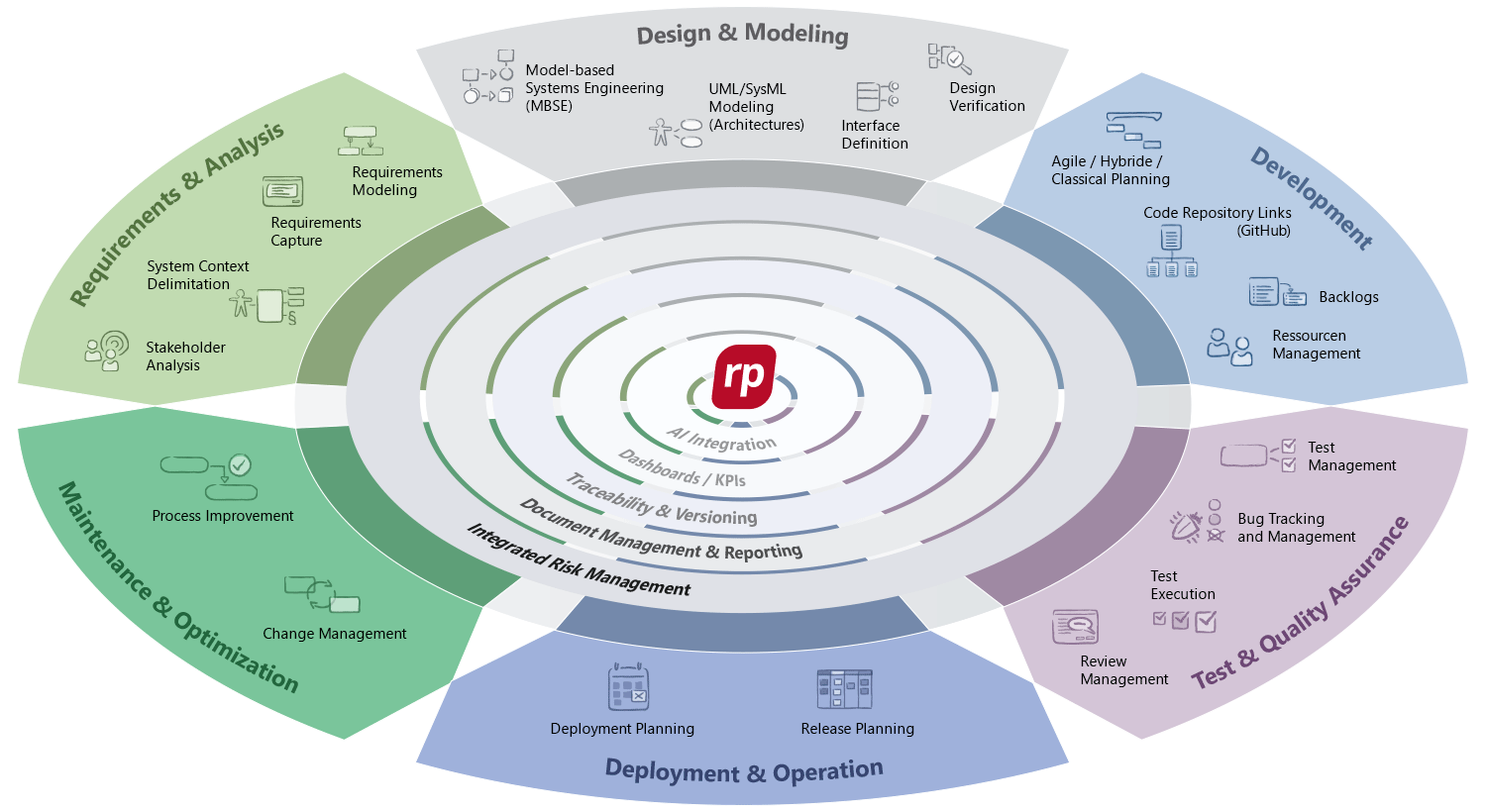
From initial requirements to deployment and maintenance, objectiF RPM is your integrated application lifecycle management (ALM) solution.
It offers full traceability and AI-supported efficiency with no media breaks.
The 6 Phases of Application Lifecycle Management in objectiF RPM
objectiF RPM streamlines the application lifecycle management process by consolidating all phases into a clear, unambiguous workflow. With historization, you can track every change and stay up to date on your decisions and progress.
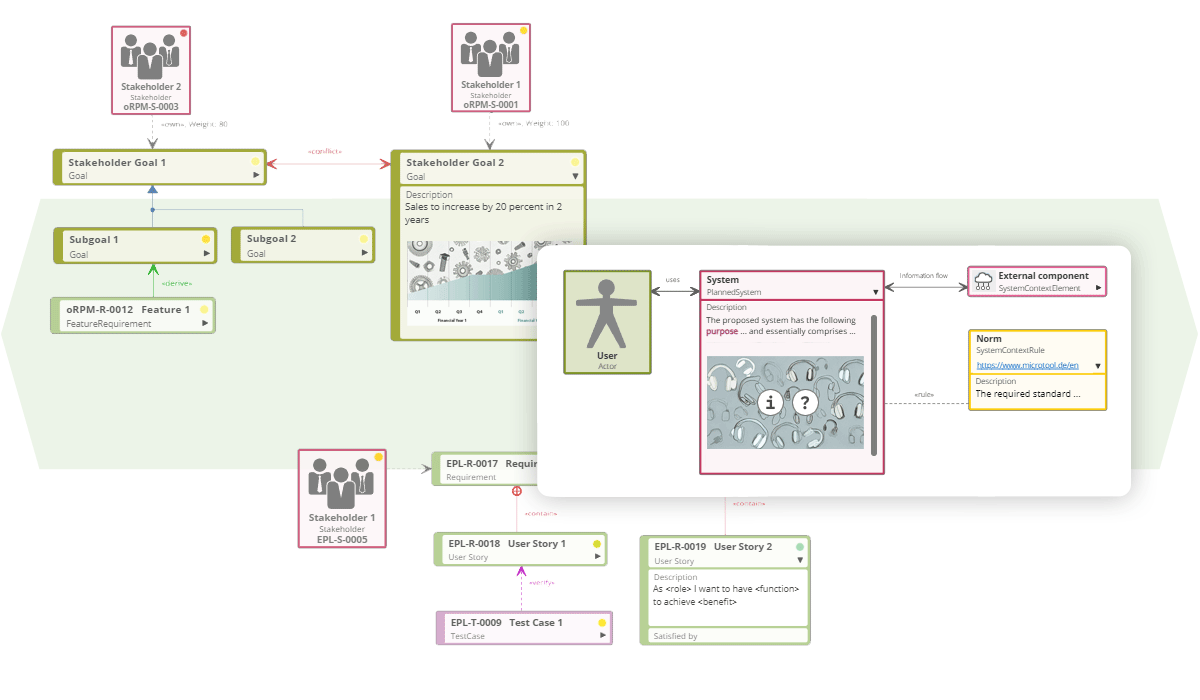
1. Requirements and Analysis
Ideas, goals, and requirements are recorded, organized, and prioritized. In-depth stakeholder analyses provide a comprehensive understanding of the framework conditions and expectations. Goal and context diagrams offer guidance. Customizable forms support consistent and efficient content recording and management. With a single click, you can generate Word or PDF documentations.
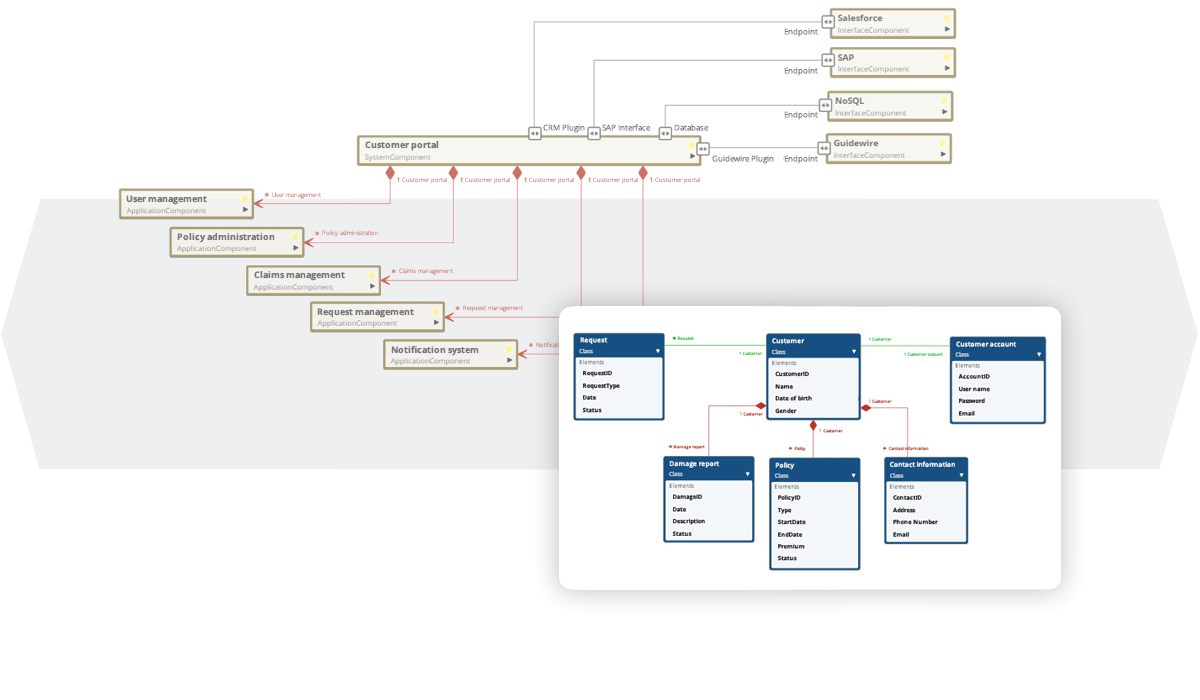
2. Design & Modeling
Using modeling systems and software (such as UML and SysML) allows you to visualize complex relationships. This creates a shared understanding of the architecture among everyone involved. The result is a structured, transparent concept that provides a solid foundation for further implementation.
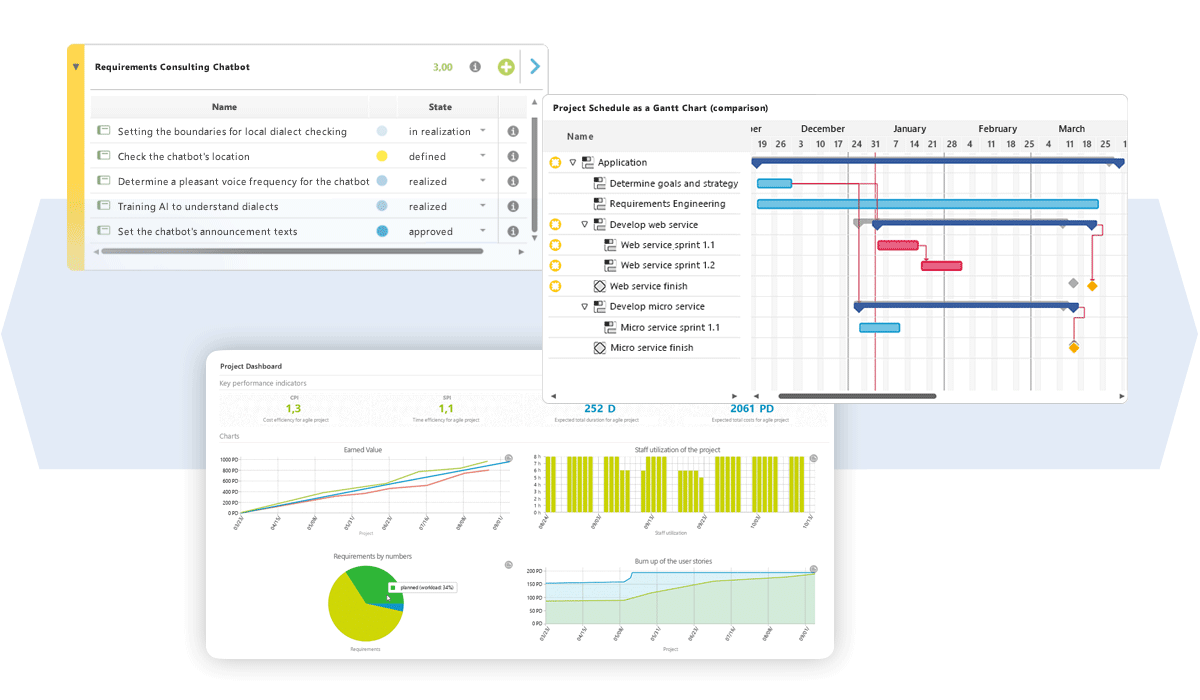
3. Development
During the development phase, requirements are transformed into actionable tasks. With objectiF RPM, you can create Gantt charts, work packages, and milestones for this purpose. To ensure end-to-end traceability, you can link requirements and activities directly. Project templates, backlogs, and boards are available across projects, enabling projects, programs, and portfolios to be based on common standards and launched efficiently.

objectiF RPM supports integrated risk management across all phases, enabling risks to be identified, assessed, and tracked systematically at an early stage.
Centralized document management and robust reporting capabilities guarantee consistent, up-to-date, and always accessible information.
End-to-end traceability and versioning ensure that changes can be tracked and that the relationships between requirements, artifacts, and decisions are clear.
Dashboards and KPIs supplement these features, providing a clear overview of the project status and enabling informed decision-making at all levels.
4. Quality Assurance & Testing
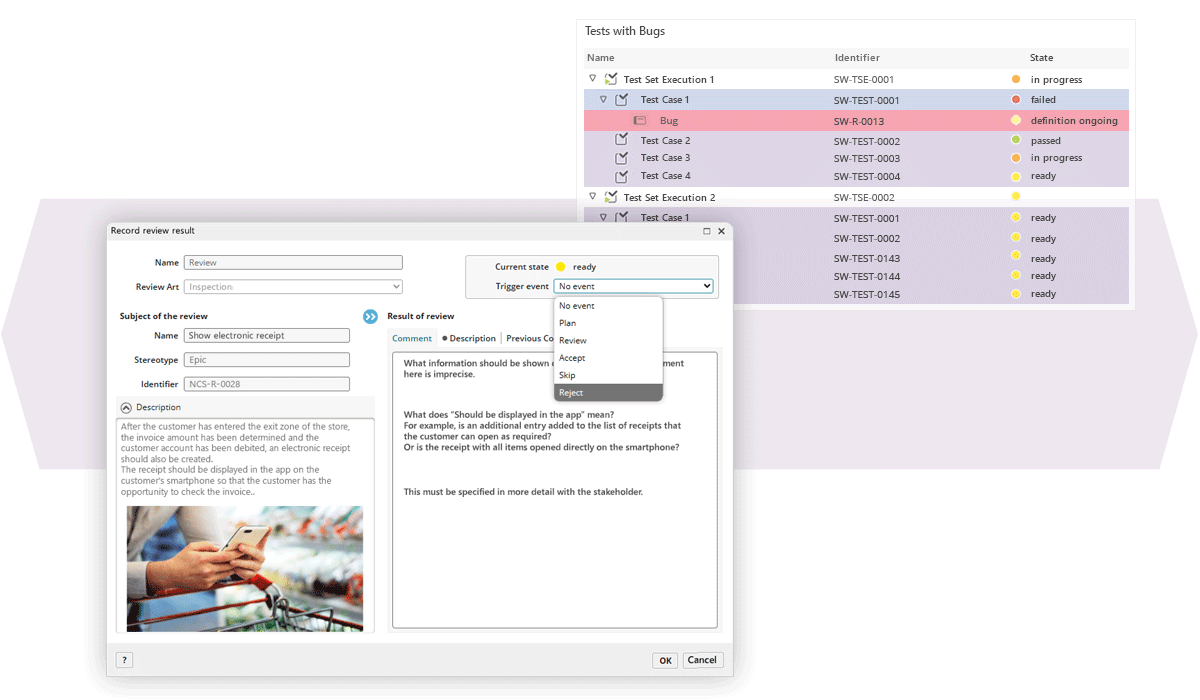
Quality assurance is an integral part of the life cycle. You determine which elements should undergo review and approval processes. As part of this process, you define test cases, create test plans, and plan and document test execution. These steps ensure that the quality of the project remains consistent, traceable, and audit-proof.
5. Deployment & Operation
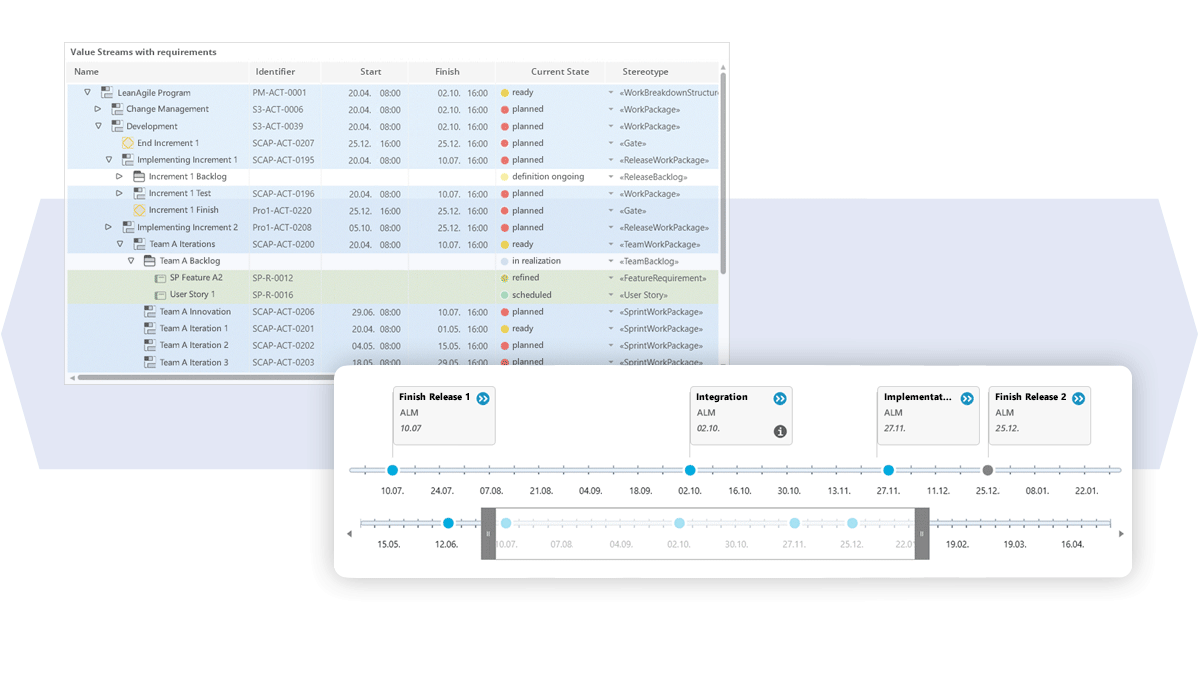
After testing is complete, you can centrally plan and control releases, versions, and deployments in objectiF RPM. Release planning provides transparency regarding content, timing, and dependencies. Deployment planning ensures that deployments are prepared, coordinated, and documented in a traceable manner. These processes establish a stable foundation for maintenance, further development, and the next release cycle.
6. Maintenance & Optimization
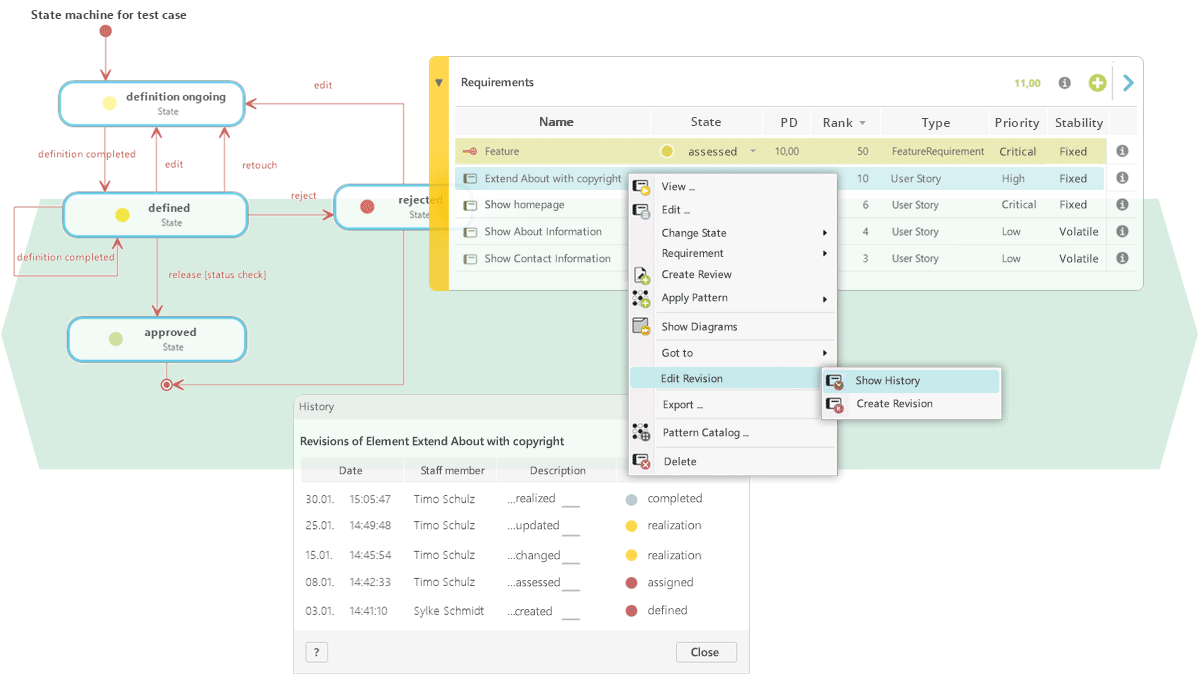
The life cycle does not end with deployment. We record and prioritize bugs and change requests, oversee their implementation, and ensure deployment is transparent and traceable. Centralized management of all incoming reports guarantees your software’s continued power and flexibility in responding to new requirements.
Why Is objectiF RPM the Top Choice for Application Lifecycle Management?
All artifacts, from goals and requirements to backlogs, test cases, releases, and resources, are consistently linked and versioned. This enables you to make informed decisions based on a single source of truth.
No matter your approach — agile, classic, or hybrid — you can adapt objectiF RPM to it. Our tool provides support in the form of Gantt charts, milestones, Scrum boards, Kanban views, and scaled structures for teams and programs.
Thanks to end-to-end traceability, you can seamlessly track connections from stakeholder goals to test results. You remain in control of your portfolio, even when working on multiple projects, thanks to scalability.
The results are faster implementation, higher quality, and reliable, transparent decisions regarding status, risks, and capacities. In short, objectiF RPM brings structure to the complexity of your ALM.
Support your Processes. Integrate AI Directly into the Tool.


Benefit from greater speed, precision, and consistency throughout the application lifecycle management (ALM) process. With generative AI in objectiF RPM, you can design projects more efficiently and at a significantly faster pace. Requirements can be generated and refined automatically. You can also create test cases with preconditions and postconditions, as well as detailed test steps, directly from the requirements.
By determining which data is transmitted to the AI, you can ensure compliance with your data protection guidelines when using generative AI.
The AI will check your requirements for similarities, redundancies, and contradictions, and will automatically provide well-founded suggestions.
Experience AI live in objectiF RPM
Integrations & Exchange
Excel and Word/ReqIF
Exchange requirements and results easily with customers and suppliers using import and export via Excel, Word, or ReqIF.
Active Directory
Securely and conveniently manage permissions centrally by transferring users directly from Active Directory.
Adaptable to Your Workflows
- Custom artifact types
- Customizable forms
- Configurable state machines
- Document templates
- Extension functions

Security, Compliance & Governance in ALM
With objectiF RPM, you can stay in control of your projects at all times. Version control, baselines, state machines, and approvals ensure clear structures. Role and rights management, as well as centrally defined standards and templates, guarantee that all team members work according to the same rules. Documentation and reports provide maximum transparency at the click of a button.
FAQ
Is objectiF RPM more suitable for agile methods or traditional approaches?
objectiF RPM supports both classic project plans with Gantt charts and agile backlogs, boards, and metrics — and even both together. If your team works in a hybrid manner, you can combine the methods flexibly according to your needs.
Is secure on-premises operation possible?
Yes, of course. objectiF RPM can operate entirely on-site. You can install it in your environment and retain data sovereignty.
Are there any additional tools I need to consider, such as Jira or Visio?
No, because one of the main advantages of ALM with objectiF RPM is the avoidance of media breaks. Functions for task management (such as Jira) and modeling (such as Visio and Enterprise Architect) are integrated into a single solution. Interfaces to third-party systems are still available.
What licensing models are available for objectiF RPM?
You can choose to purchase perpetual licenses for unlimited use or subscribe to a rental plan. There are also two types of licenses: named user (assigned to a specific user) and concurrent user (floating licenses for different employees). This gives you maximum flexibility in scaling.
Is it possible to use objectiF RPM in a web browser?
Yes, objectiF RPM offers a hybrid architecture. In addition to the robust Windows client designed for power users, a web service allows access via a browser. This makes it particularly easy for stakeholders and external employees to access, as no local installation on their computers is necessary.
Does objectiF RPM support data exchange via ReqIF?
Yes, objectiF RPM supports the ReqIF (Requirements Interchange Format) standard for exchanging requirements with customers and suppliers. The import and export functions are fully integrated, enabling you to exchange requirements and specifications without losing any data.
What kind of support is available for implementing the software?
microTOOL offers a wide variety of training courses. These include webinars, seminars, and individual tool training sessions. You can also benefit from consulting services that will help you integrate the software optimally into your existing infrastructure and process landscape.
Is objectiF RPM more suitable for agile methods or traditional approaches?
objectiF RPM supports both classic project plans with Gantt charts and agile backlogs, boards, and metrics — and even both together. If your team works in a hybrid manner, you can combine the methods flexibly according to your needs.
Is secure on-premises operation possible?
Yes, of course. objectiF RPM can operate entirely on-site. You can install it in your environment and retain data sovereignty.
Are there any additional tools I need to consider, such as Jira or Visio?
No, because one of the main advantages of ALM with objectiF RPM is the avoidance of media breaks. Functions for task management (such as Jira) and modeling (such as Visio and Enterprise Architect) are integrated into a single solution. Interfaces to third-party systems are still available.
What licensing models are available for objectiF RPM?
You can choose to purchase perpetual licenses for unlimited use or subscribe to a rental plan. There are also two types of licenses: named user (assigned to a specific user) and concurrent user (floating licenses for different employees). This gives you maximum flexibility in scaling.
Is it possible to use objectiF RPM in a web browser?
Yes, objectiF RPM offers a hybrid architecture. In addition to the robust Windows client designed for power users, a web service allows access via a browser. This makes it particularly easy for stakeholders and external employees to access, as no local installation on their computers is necessary.
Does objectiF RPM support data exchange via ReqIF?
Yes, objectiF RPM supports the ReqIF (Requirements Interchange Format) standard for exchanging requirements with customers and suppliers. The import and export functions are fully integrated, enabling you to exchange requirements and specifications without losing any data.
What kind of support is available for implementing the software?
microTOOL offers a wide variety of training courses. These include webinars, seminars, and individual tool training sessions. You can also benefit from consulting services that will help you integrate the software optimally into your existing infrastructure and process landscape.
objectiF RPM for Application Lifecycle Management and more
objectiF RPM supports companies in managing software projects and other initiatives from start to finish, in various areas. Find out how objectiF RPM creates transparency, traceability, and control throughout the entire lifecycle, and explore the functions, processes, and application scenarios.