
Who Is Involved in Developing the Requirements Specification?
- Client: Bears overall responsibility
- Stakeholders: Line departments, management, and IT security
- Users: Provide functional requirements based on practical experience
- Requirements Engineer/Business Analyst: Facilitates identification of requirements and structures results
A requirements specification does more than define the desired service. It also defines the conditions under which the service is considered successfully delivered.
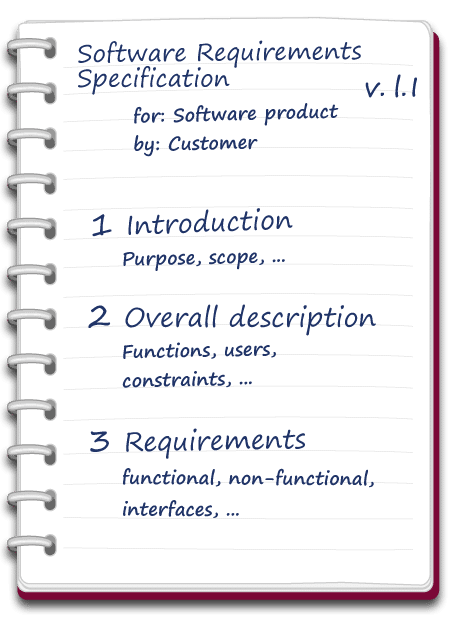
In a software requirements specification, the customer forms the desired requirements for the system under development without getting into the technical implementation.
There are no regulations for the structure and content of the software requirements specification. Generally, at least three chapters are needed: An introduction, a product description and a description of the requirements.
Below are some examples:
Classification According to Balzert
1. Objective Definition
2. Product Usage
3. Product Functions
4. Product Data
5. Product Performance
6. Quality Requirements
7. Additional Requirements
Software Requirements Specification (SRS)
According to the IEEE:
1. Introduction
- Purpose: Who is this document for? What is its objective?
- Scope: Which product is described? What is explicitly out of scope?
- Definitions and Acronyms: A glossary is provided to avoid terminological misunderstandings.
- References: Links to related documents, such as the business case or higher-level system specifications.
2. Overall Description
- Product Perspective: Is the software a standalone product or part of a larger system?
- Product Functions: A summary of the main functions, often illustrated with a use-case diagram.
- User Characteristics: Who are the users? What prior knowledge do they have?
- Constraints: Legal requirements, hardware limitations, and mandatory protocols.
- Assumptions and dependencies: Which external factors (e.g., third-party APIs) influence project success?
3. Specific Requirements
- External Interfaces: A detailed description of the user interface (UI), hardware interface, and software interface (API).
- Functional Requirements: Detailed logic, input validation, and data processing for each function.
- Performance Requirements: Static and dynamic requirements (e.g., number of concurrent users and response times under load).
- Software attributes: Requirements for reliability, availability, security, and maintainability.
Logical database requirements: Which information entities must be stored persistently? (e.g., ER models or class diagrams).
Comparing Standards and Frameworks
| Key Characteristics | Typical Use | |
|---|---|---|
| Balzert (Classic) | Didactically clear structure with a focus on completeness of chapters | Standard approach in software engineering projects in the D-A-CH region |
| IEEE 29148 | Emphasis on precise language (“shall” statements) and logical hierarchy | International IT projects |
| V-Model XT | Highly formalized product templates (requirements document as “Customer Requirements”) | Public sector and government projects in Germany |
| IREB Standard | Focus on quality criteria of requirements (atomicity, verifiability) | Method-driven organizations |
| ISO/IEC 25010 | Focus on software quality characteristics (non-functional requirements) | Highly critical systems (e.g., safety, usability) |
Requirements Specification vs. Functional Specification
The terms “requirements specification” and “functional specification” are often confused. However, it is essential to distinguish between them for legal and professional clarity.
| Requirements Specification | Functional Specification | |
|---|---|---|
| Responsibility | Client (customer) | Contractor (supplier) |
| Key Question | WHAT is needed? (problem space) | HOW will it be implemented? (solution space) |
| Legal Status | Basis for tendering | Basis for contract and implementation |
In practice, these documents are frequently mixed or combined.
Effectively Documenting Requirements
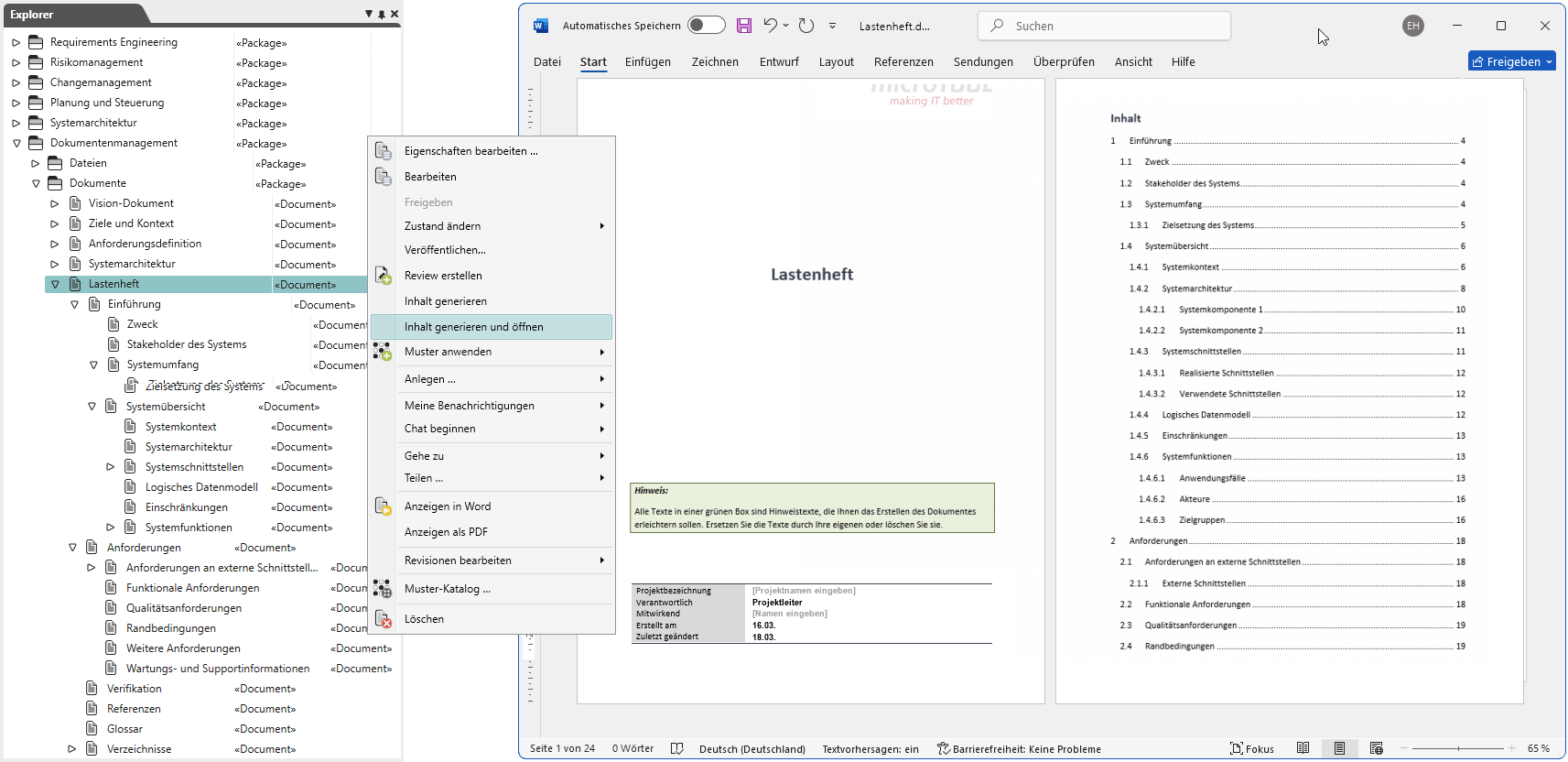
With objectiF RPM, however, the requirements specification evolves from a “dead document” into a dynamic data foundation. Instead of writing a lengthy document, requirements are managed as database objects, and an up-to-date specification can be generated from them at any time. Your benefits:
- Structured at the click of a button: Use a ready-made, standards-compliant template that can be applied as is or tailored to your needs.
- Visual modeling: Integrate diagrams (e.g., goals, system context, and use cases) directly into the specification.
- Real-time documentation: Generate an up-to-date requirements specification as an MS Word or PDF document directly from the tool.

Try objectiF RPM
Test objectiF RPM free of charge for 30 days—with full functionality, including templates for requirements engineering and project management.
FAQ
Does a requirements specification fit into Agile development?
What is the biggest risk associated with a requirements specification?
Is a requirements specification legally binding?
How detailed should a requirements specification be?
Want to Know More?
What is Requirements Engineering?
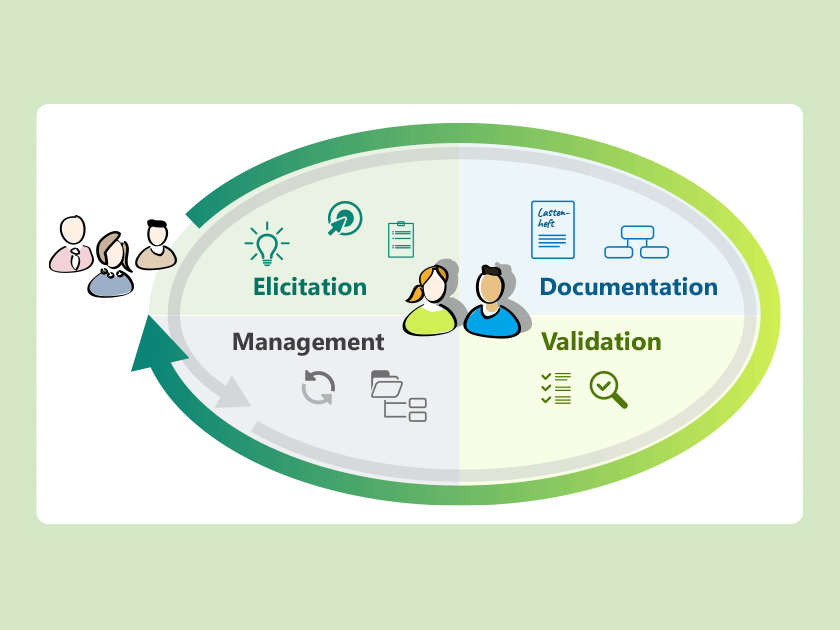
Requirements engineering (RE) involves eliciting, documenting, validating, and managing requirements. Learn how professional RE can safeguard your projects.
What is CPRE?
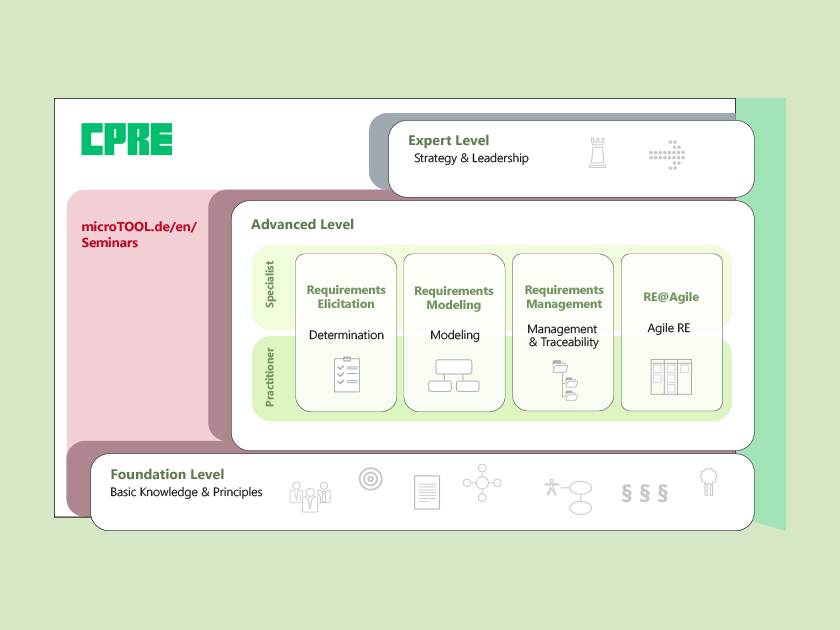
The CPRE (Certified Professional for Requirements Engineering) is the international standard for RE certification. Find information on the program’s content, levels, and exams.
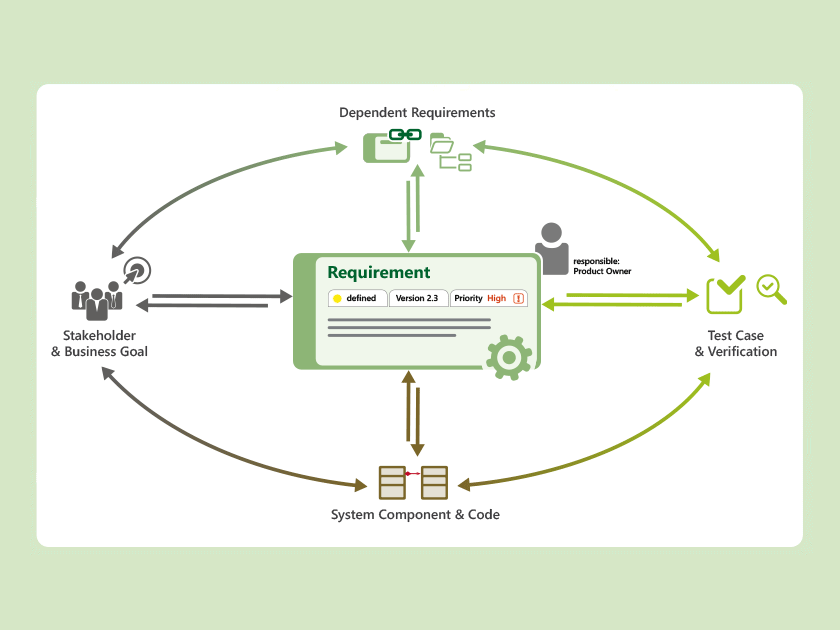
What is Requirements Management?
Requirements management (RM) involves managing requirements throughout their lifecycle. Learn how RM differs from requirements engineering and how tools can assist with the process.
objectiF RM – Whitepaper
Requirements Engineering for Software and Systems. Read about benefits and options of objectiF RM in this whitepaper.

objectiF RPM – Whitepaper
Increase your business agility. Get to know objectiF RPM in this whitepaper. From the needs of stakeholders to IT systems for successful business.