

Agile project management is an iterative approach to planning and executing projects. It emphasizes flexibility, continuous improvement, and a strong customer focus. Unlike traditional project management, requirements are not fully defined at the beginning, but rather developed and refined in short cycles (iterations or sprints). This allows teams to adapt quickly to changes and provide usable results early and frequently.
Core Values
Agility is more than a methodology; it’s a mindset. Agile project management challenges traditional roles, processes, and rigid planning approaches.
Four core values define all Agile practices:
Individuals and interactions over processes and tools
To unlock the full potential of everyone involved, teams need room to act, not rigid, restrictive processes. Progress is driven by people and communication, not tools alone.
Working software is prioritized over comprehensive documentation
More broadly, this can be understood as valuing outcomes over excessive documentation. Agile prioritizes continuously delivering functional results rather than producing lengthy reports. Stakeholders prefer tangible results to documentation about them.
Customer collaboration vs. contract negotiation
Instead of investing heavily in lengthy contract negotiations, Agile approaches focus on early execution and ongoing stakeholder feedback, which is continuously incorporated into the work.
Responding to change over following a plan
Traditional approaches execute predefined requirements. However, few projects are entirely predictable from the start. Agile embraces change, adapting plans as needed to ensure the outcome aligns with stakeholder expectations, even if the original scope evolves.
Origins
In the 1990s, dissatisfaction with heavyweight software development processes grew. In 2001, a group of industry leaders came together to define a new approach, resulting in the Agile Manifesto. Over time, this evolved into modern agile project management, which is now applied far beyond software development.
The Agile Way of Working: Empiricism, Iterations, and Increments
Agility is not just about speed; it’s a response to complexity. Its key characteristics include:
1. Empiricism (learning through experience)
Traditional projects follow a “plan-and-control” model. Agile, however, is based on empiricism—the idea that knowledge comes from experience and decisions should be grounded in observation. Its three pillars are:
- Transparency: All stakeholders have visibility into progress and processes.
- Inspection: Results and workflows are frequently reviewed.
- Adaptation: If deviations occur, adjustments are made immediately.
2. Iteration vs. increment: Process vs. outcome
These two concepts are central to agile delivery.
- Iteration (the process cycle): A fixed time frame, called a “sprint” in Scrum, during which a defined set of work is completed.
- Increment (the result): A tangible, usable addition to the product that is delivered at the end of each iteration. The increment must be “done” and provide real value.
3. Feedback loops: Built-in course correction
In traditional project management, problems often go unnoticed until the final acceptance process. Agile minimizes risk through feedback-loops.
- Close customer interaction: Regular reviews (after every iteration) ensure direct stakeholder input.
- Early issue detection: Each increment allows for immediate validation, reducing the need for costly rework later on.
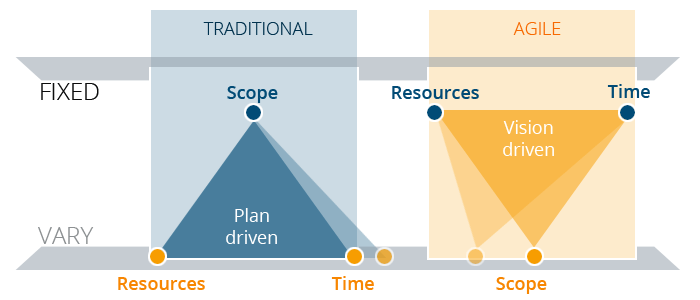
Reversing the Magic Triangle
A fundamental shift in thinking occurs with the so-called “magic triangle“:
In traditional project management, the scope is fixed while time and cost are estimated, which often leads to delays or budget overruns.
Agile turns this model around:
- Fixed parameters: Time (sprint duration) and resources (team/cost)
- Variable parameter: The scope is the variable quantity
Instead of asking, “When will all features be delivered?” Agile asks,
“Which valuable features can we deliver within this timeframe and budget?” This approach ensures predictable delivery timelines while maintaining quality by adjusting scope as needed.
Common Frameworks: Scrum, Kanban and More
Widely used agile frameworks include:
Scrum: Centers on defined roles (product owner, scrum master), events (sprints, daily stand-ups), and artifacts (backlog)
Kanban: Emphasizes workflow visualization and limiting work in progress (WIP)
Design Thinking: Focuses on user-centered problem solving, especially in the early phases
Traditional vs. Agile
Weighing the fundamental differences between traditional and agile project management approaches is helpful for making the right choice for a project.
| Traditional Project Management | Agile Project Management | |
|---|---|---|
| Planning | Extensive upfront planning | Continuous, iterative planning (rolling wave). |
| Requirements | This is specified in the requirements specification and technical specifications | Flexible (managed in backlog) |
| Changes | Difficult and costly (change requests). | Expected and welcomed |
| Delivery | Single release at the end | Continuous delivery of increments |
| Roles | Centralized project manager delegates tasks | Self-organizing teams (scrum roles) |
| Customer Focus | Primarily at final acceptance | Continuous throughout every cycle |
When to Use Which Approach?
Using agile methods is not an end in itself. While the waterfall approach is ideal for projects with a high degree of predictability (e.g., construction), agility is standard for software development and innovation projects. One key factor is the stability of the requirements. The less clear the goal is at the outset, the more agile the management approach should be.
Agile Project Management in Practice
In agile project management, the main pain points are usually a lack of overview when scaling up with many teams and backlogs, and a lack of traceability for stakeholders.
This can lead to:
- “Agile chaos“ with large backlogs: Simple task boards quickly become confusing when hundreds of requirements need to be prioritized across multiple teams.
- The “reporting gap“: Stakeholders demand reliable forecasts and status reports, but the team only provides Agile metrics, such as velocity and burn-down charts, which management finds difficult to interpret.
With objectiF RPM, you can manage complex backlogs across multiple teams. Use them interactively for planning and rest assured that traceability is maintained.
Unlike simple task boards, objectiF RPM offers dashboards that link agile progress, such as burn-down charts, to strategic project goals.

True Agility and Structure
Manage your backlogs, sprints, and boards right alongside your requirements. Learn how to shorten your time to market while maintaining full transparency into your goals.
FAQ
When is agile better than traditional project management?
Agile project management is ideal for situations involving high uncertainty and complex requirements when the final product cannot be precisely defined at the outset.
Does agile eliminate planning?
No, planning is very intensive. However, it’s not done just once in advance. Instead, it’s done continuously (“rolling wave planning”) before each iteration.
Can agile and traditional approaches be combined?
Yes, this is known as hybrid project management. It uses traditional milestones for budgeting and agile sprints for development, for example.
Do You Want to Know More?
Explore more knowledge base articles online or download one of our whitepapers.
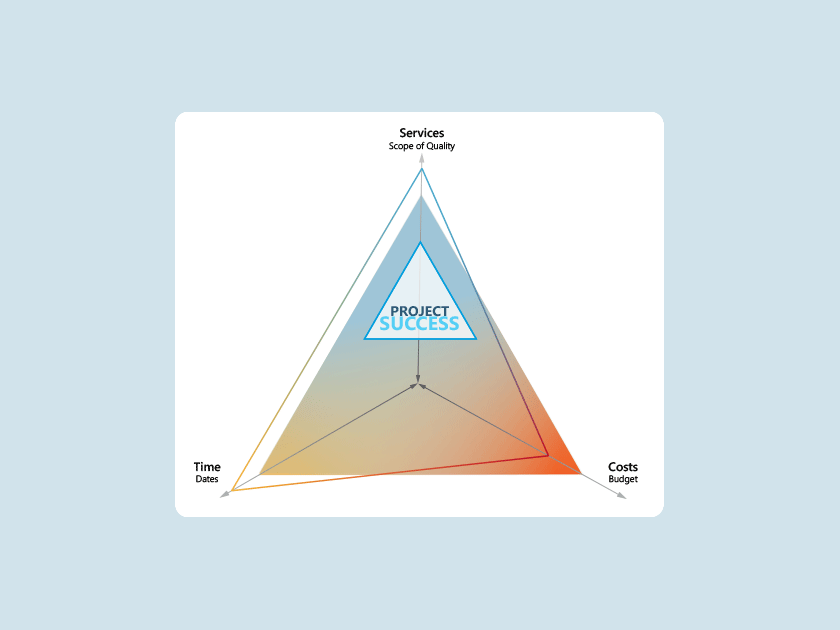
What is the Triple Constraint?
The triple constraint represents the three key success factors of a project: time, cost and scope. If one of these factors changes, it inevitably affects at least one of the other two. Project management therefore means continuously balancing these factors and addressing conflicting objectives at an early stage.
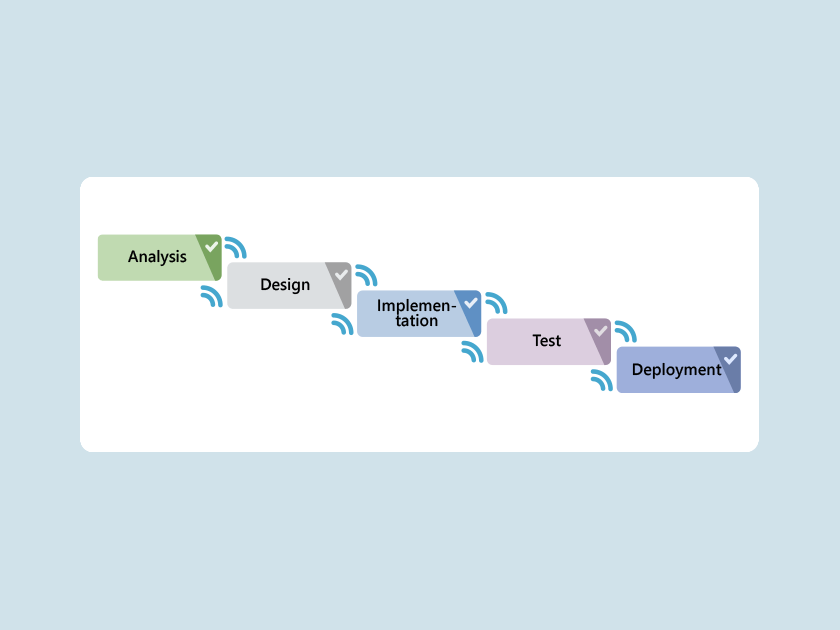
What is Traditional Project Management?
This is a clear explanation of traditional project management, including phases, milestones, and the Waterfall model, as well as a table of activities, artifacts, and outcomes.
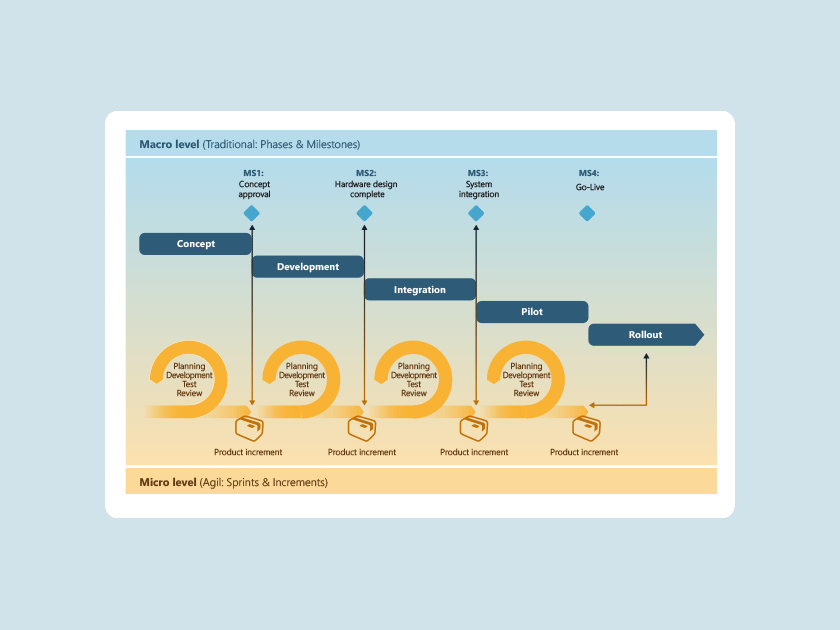
What is Hybrid Project Management?
Hybrid project management combines traditional planning with agile methods. This enables companies to maintain control over milestones, compliance and budgets while allowing teams to work flexibly and iteratively. With objectiF RPM, both approaches can be managed within a single, centralised platform.
objectiF RPM – Whitepaper
Increase your business agility. Get to know objectiF RPM in this whitepaper. From the needs of stakeholders to IT systems for successful business.
objectiF RM – Whitepaper
Requirements Engineering for Software and Systems. Read about benefits and options of objectiF RM in this whitepaper.