
The Golden Circle is a leadership model developed by Simon Sinek. It describes how inspiring organizations communicate and act. The model reverses the usual way of thinking. The Golden Circle consists of three concentric circles: Why, How, and What. Its central idea is encapsulated in Sinek’s famous statement: “People don’t buy what you do; they buy why you do it.” Therefore, successful strategies begin at the center with the “Why” (why we do something), not the “What” (what we offer).
The Three Levels of the Circle
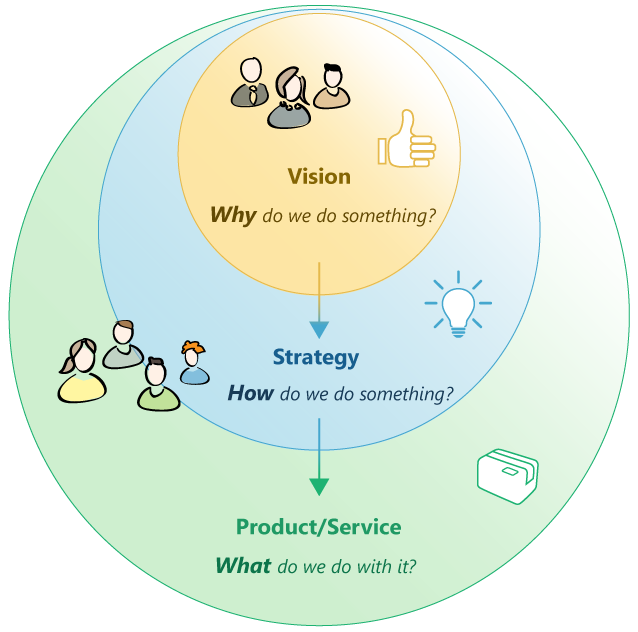
Most companies know what they do. However, few truly understand why they do it. The Golden Circle’s core idea is to start with the question “Why?” and communicate from the inside out across three levels.
The “Why”
(Center of the Golden Circle – the Vision)
This level is about articulating the fundamental belief that drives everything the organization does. Why does the company exist (beyond making money)?
Example: “We want to challenge the status quo.”
The “How”
(the Middle Ring – the Strategy)
These are the unique approaches and methods that turn the “Why” into reality.
Example: “We design user-friendly, extremely efficient products.”
The “What”
(the Outer Ring – the Product or Service)
This is where the specific product or service is described.
Example: “We build maintenance-free heating systems.”
The Biology of Decision-Making
Sinek also explains the model from a biological perspective. The outer ring (What) corresponds to the neocortex, which is responsible for language, rational thinking, and analytical reasoning. The inner rings (Why and How) correspond to the limbic system, which governs emotions, trust and decision-making, but lacks the capacity for language. This is why figures alone (for example, OKRs without a vision) rarely motivate people. They only appeal to the neocortex.
The management takeaway: If you only talk about numbers and features (What), you will only reach the mind, not the heart. Genuine enthusiasm, motivation and loyalty originate in the limbic system, and are triggered by a strong Why.
Why the Golden Circle is the Foundation for OKR
Many OKR implementations fail because they start with the ‘How’ or ‘What’ without first ensuring that employees understand the underlying purpose. The result is often nothing more than a list of empty goals.
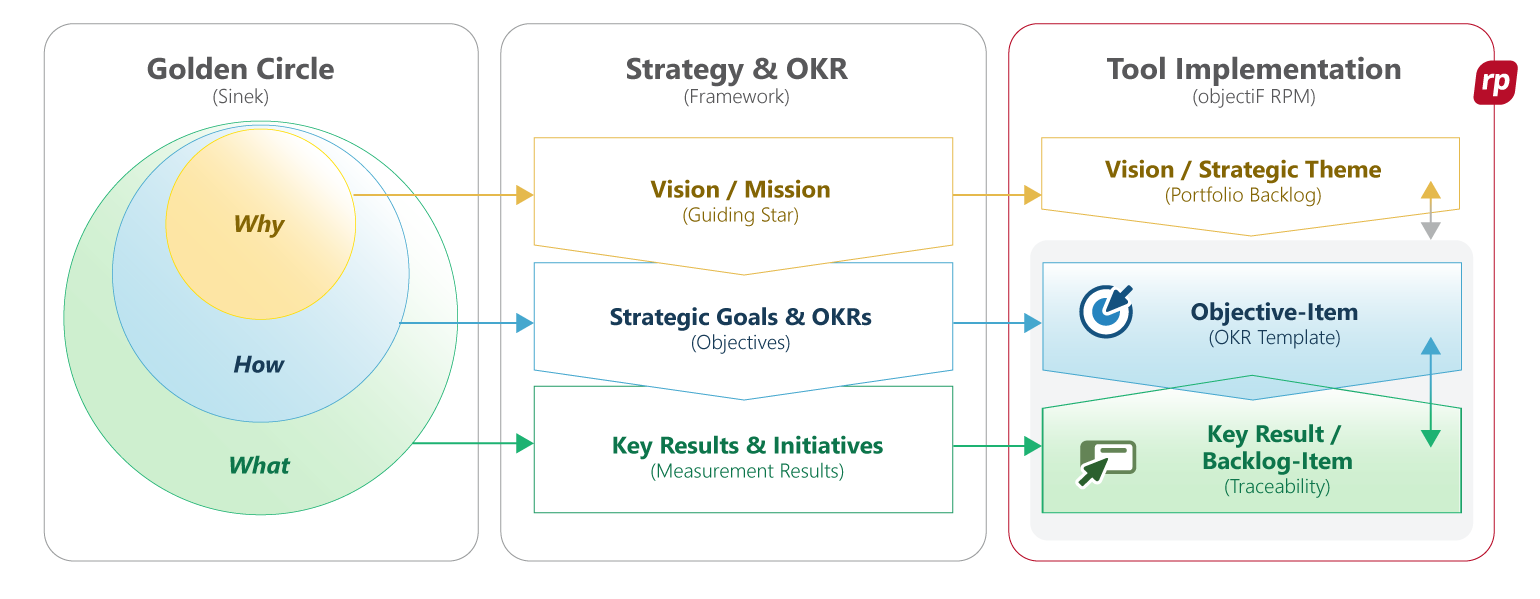
The ‘Why‘ acts as a guiding principle: Before defining the first ‘Objectives’ or quarterly goals, the ‘Why’ must be clear to everyone. It represents the long-term vision, typically over a 5–10 year horizon.
The ‘How‘ then becomes the ‘Objectives’: OKRs translate the broader ‘Why’ into concrete strategic steps for the next year or quarter.
The ‘What‘ becomes the ‘Key Results’ and ‘User Stories’: These represent the operational implementation — the measurable outcomes and tasks in the backlog.
Once your ‘Why’ has been defined, it must be translated into measurable outcomes. Our article on Objectives and Key Results (OKR) explains how this works in detail.
Why Use OKR?
There are four compelling reasons to adopt OKR:
- Focus: teams typically limit themselves to three to five objectives per cycle, each with no more than three to five key results. Because if everything is important, nothing is important. Less is more.
- Alignment: goals are not simply dictated from above. Teams often develop their OKRs from the bottom up, based on company goals. This ensures that everyone is working towards the same goal.
- Transparency: in most organisations, all OKRs are visible to everyone.
- Stretch Goals: OKRs are intentionally ambitious. Achieving 70% of a goal is often considered a success, reflecting the ‘moonshot’ mindset.
From Purpose to Backlog
In practice, the connection to the original vision is often lost during the development process. Teams work productively, but without a clear understanding of the bigger picture. Without context, motivation fades.
objectiF RPM makes the relationship between vision, objectives, key results and requirements (user stories) visible to everyone involved. A dedicated OKR template supports this process.
The Professional OKR Tool
Discover OKR, supported by objectiF RPM.
FAQ
Is the Golden Circle just a marketing concept?
No. While it is popular in marketing and branding, its strongest impact is in leadership and product development. It acts as a strategic filter: “Does this new feature really align with our Why?”
How does a 'vision' differ from a 'mission'?
The why is often timeless and emotional (belief). The mission, on the other hand, is more action-oriented: ‘What do we do every day to achieve the why?’. In practice, these boundaries often blur, but the important thing is that purpose comes before planning.
Can OKR Work without the Golden Cycle?
Technically, yes, but it’s risky. Without a shared why, OKRs quickly feel like an arbitrary to-do list from management (‘command and control’). The why provides the intrinsic motivation for tough goals (‘mission command’).
Want to Know More?
Explore more knowledge base articles online or download one of our whitepapers.
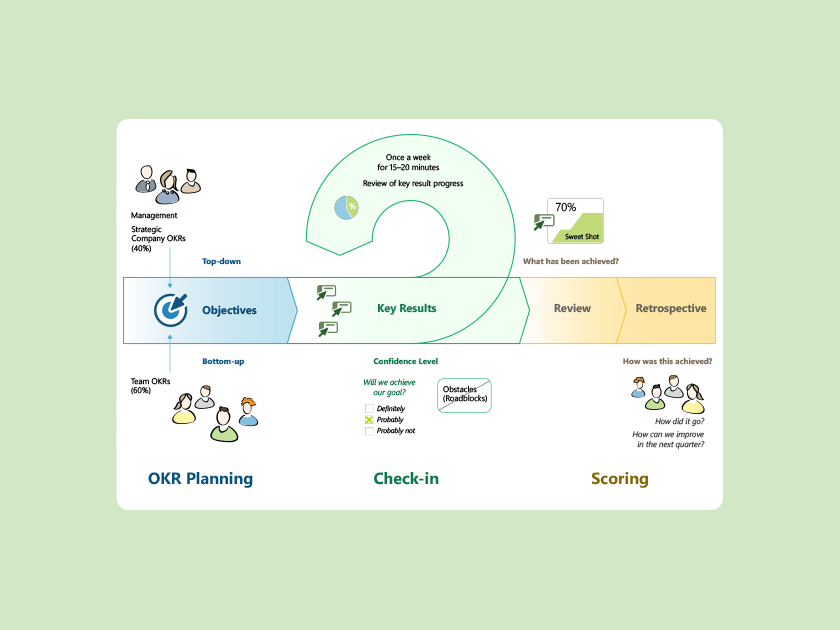
What is OKR?
OKR explained simply: How to set agile goals with Objectives and Key Results. Learn the difference between KPIs and how to integrate strategy with operational implementation.
What is Requirements Engineering?
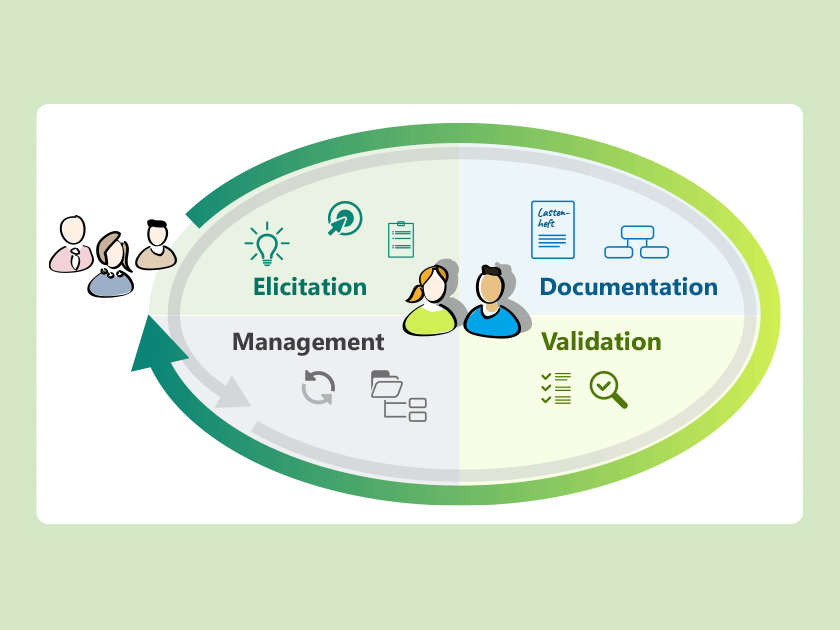
Requirements engineering (RE) involves eliciting, documenting, validating, and managing requirements. Learn how professional RE can safeguard your projects.