

Test management involves planning, controlling, executing, and monitoring all testing activities in software development. It is an ongoing process that ensures the defined requirements have been implemented correctly, not merely a final check. Effective test management begins in the requirements analysis phase to minimize defect costs early on („Shift Left“).
Testing Begins with Requirements Engineering
One common misconception is that testing only begins once the code has been written. In fact:
A requirement that cannot be tested is incomplete.
In modern test management, test cases are often derived from requirements before development begins. This requires precise wording. If a requirement (“The system should be fast.“) does not allow for a clear acceptance test (“Load time < 2 seconds.“), then it must be specified in more detail.
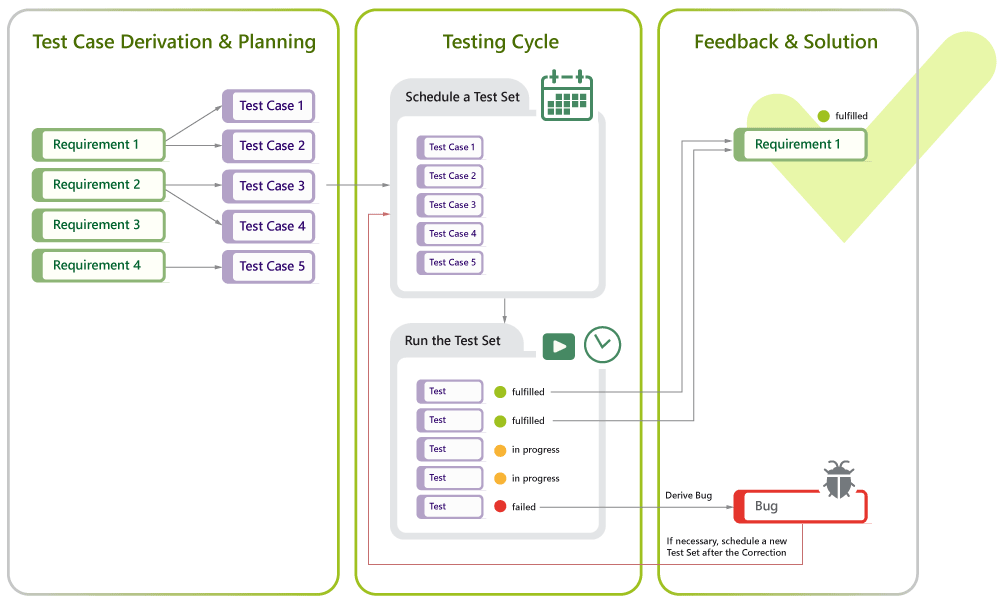
The Core Process: From Test Case to Test Set Execution
In order to understand test management from an operational perspective, it is important to distinguish between the following terms:
1. The Test Case
This is an abstract description of what is being tested, such as “Login with an incorrect password.“ This test case is reusable.
2. The Test Set
A single test case does not prove anything on its own. Test cases are grouped into test sets for the purpose of planning test execution (e.g., “Regression Test V 2.0” or “Smoke Test Sprint 5”).
3. The Test Set Execution
This refers to a specific run at a given point in time. It documents whether the test case “passed“ or “failed“ in the current build. The same test case may pass in Test Set A but fail in Test Set B two weeks later.
Manual vs. Automated Test Management
Test management coordinates both:
- Manual testing: Important for usability and complex scenarios (exploratory testing).
- Automated testing: Important for rapid regression testing in continuous integration/continuous delivery (CI/CD).
An effective management tool consolidates results from both types of testing into a single, centralized report. This report provides an at-a-glance view of the overall quality status, regardless of whether human or automated testing was performed.
Speaking of tools: Why use separate tools for requirements and testing when the two are so closely intertwined?
objectiF RPM seamlessly combines the fields of requirements engineering and quality assurance.
- Requirements ↔ Test cases: Test cases can be derived directly from requirements or user stories in the backlog. Traceability is automatically ensured.
- Planning and execution with test sets: Define test sets by combining test cases from the backlog or previous test set executions. You can centrally control who performs which tests and when. Progress during testing is displayed via appropriately configured dashboards. If errors are detected during testing, bugs can be traced directly. Since everything is stored in a central repository, developers can see the errors and have direct access to the underlying requirements via traceability.
- Workflow automation & state machines: The greatest driver of efficiency lies in integrated workflows. You define the interaction of the state machines for test cases, tests, and test set executions in objectiF RPM as the foundation for automation to align with your processes.


Full Traceability without Additional Effort
With objectiF RPM, you can integrate requirements engineering, test management, and defect tracking into one centralized system. This enables you to monitor quality and progress at all times.
FAQ
What happens if a test set fails?
If a test fails, it is logged, and a bug or defect is usually created. A test set is often not considered “complete” until all critical defects have been fixed or a retest is successful.
When does testing end? (Exit criteria)
Testing never ends “randomly,” but rather when the defined exit criteria are met.
Examples:
– 100% of critical test cases are passed.
– There are no open high-priority bugs.
– Code coverage is greater than 80%. Test management continuously monitors these metrics.
Is test management worth it even in agile projects?
Absolutely. In Scrum, for instance, acceptance criteria for a user story are essentially test cases. A tool can help you keep track of the growing number of regression tests.
Does exploratory testing replace traditional test management?
No, it complements it. In exploratory testing, the tester searches for defects intuitively, without following a rigid script. However, the results must be documented (e.g., as “session-based testing”) so that any bugs found can be reproduced and incorporated into the official defect workflow.
In what ways does test management help with audits and the duty to provide evidence?
In regulated industries, such as automotive and medical technology, end-to-end traceability is mandatory. With a tool, you can demonstrate that requirement X was successfully verified by test case Y in test set Z on date D, which is virtually impossible to do without a tool.
Want to Know More?
Explore more knowledge base articles online or download one of our whitepapers.
objectiF RM – Whitepaper
Requirements Engineering for Software and Systems. Read about benefits and options of objectiF RM in this whitepaper.
objectiF RPM – Whitepaper
Increase your business agility. Get to know objectiF RPM in this whitepaper. From the needs of stakeholders to IT systems for successful business.
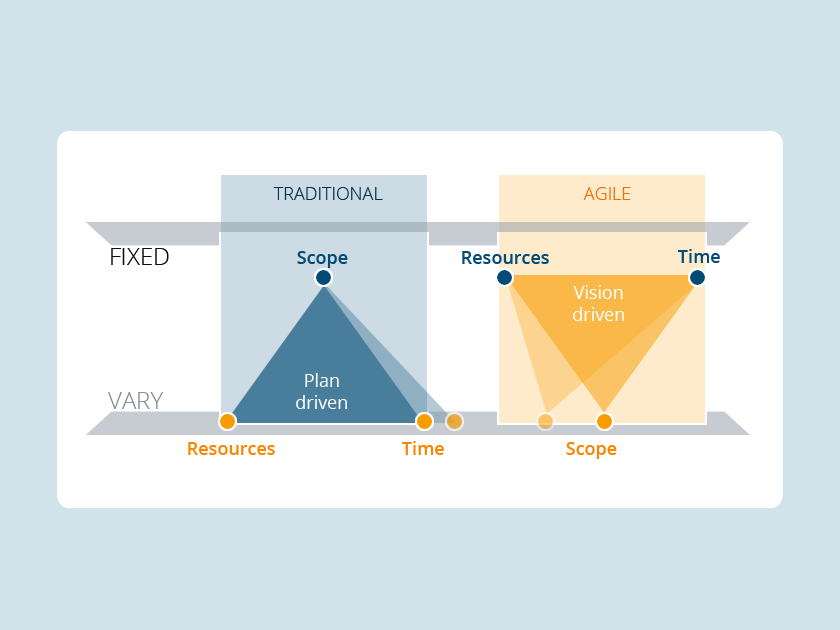
What is Agile Project Management?
Agile Project Management Explained: An Overview of Values, Methods, and Benefits—Including a Comparison to Traditional Approaches