
Traditional project management is a plan-oriented approach in which a project is divided into clearly defined, sequential phases. Each phase concludes with a defined outcome (milestone). A transition to the next phase occurs only after a milestone has been reached. The most prominent examples are the waterfall model, which represents the flow of activities, and the V-model, which ensures that each development phase is validated by a corresponding verification step.
Basic Structure of Traditional Project Management
Traditional project management involves managing the complexity of a project by dividing its lifecycle into manageable, time-bound phases. Each phase has a specific technical focus and lays the foundation for the next step.
Each phase ends with a milestone. These milestones act as “quality gates.” A project can only advance to the next stage once the results of the previous phase are available and formally accepted. This prevents planning errors or unclear requirements from going unnoticed and being carried over into the implementation phase.
What makes this approach unique? Traditional management is plan-oriented. A significant amount of effort is invested in analysis and design at the outset to avoid costly and difficult changes later on.
Advantages & Application of Traditional Project Management
Traditional project management excels when based on the fundamentals of project management:
- The requirements are stable and fully understood
- There are fixed-price quotes or rigid deadlines (the magic triangle)
- There are strict regulatory requirements for documentation
The Waterfall Model: A Pure Phase-Based Approach
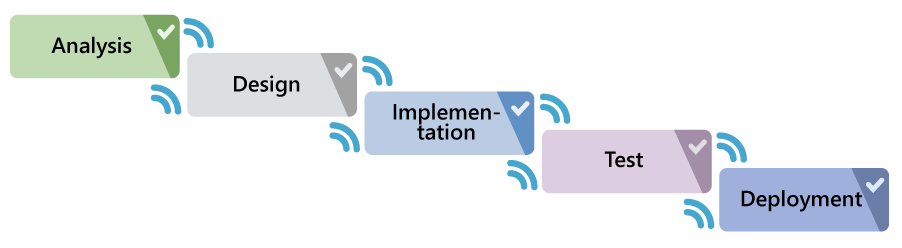
The waterfall model is the purest and most well-known form of implementing a phase model. While the phase model provides an organizational framework, the waterfall model offers strict workflow guidelines. It views the project as a continuous, downward-flowing stream.
In relation to the general phase model, the waterfall model serves as its methodological framework. It reinforces the logic of “quality gates” by establishing a strict, one-way rule. The pure waterfall model does not allow for a return to a previous stage. This means: The project “falls” into the design (the planning phase) only when the results of the analysis (from the definition phase) are 100% finalized. This tight interlocking ensures extremely high documentation standards, but it also requires error-free preparatory work at every stage.
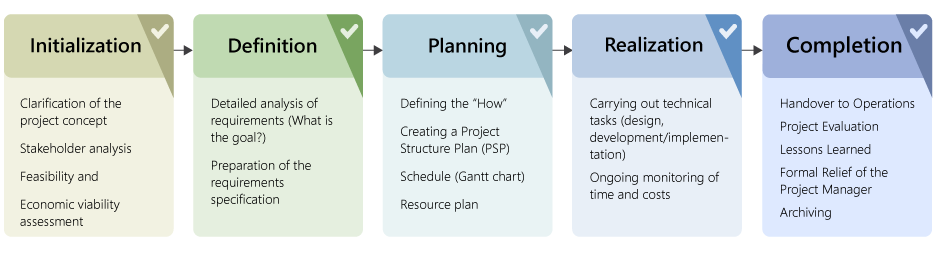
Comparison: Phases of the General Phase Model vs. Stages of the Waterfall Model
Figure 1 provides an organizational overview of the project workflow. However, practical implementation, especially in quality-critical areas, requires a more nuanced distinction. The verification phase (testing) is intentionally listed separately in the following overview.
| Waterfall Stage | Core Activities & Artifacts | Milestone (Outcome) | |
|---|---|---|---|
| 1. Initiation | Preparation | Project idea, feasibility analysis, stakeholder analysis | Project approval (project charter issued) |
| 2. Definition | Analysis | Elicitation of requirements, definition of objectives. Artifact: Requirements specification | Requirements specification approved |
| 3. Planning | Design | Creation of system architecture, scheduling (Gantt chart), resource planning. Artifact: Functional specification | Project plan finalized (baseline established) |
| 4. Execution | Implementation | Functional realization, programming or construction. Ongoing controlling | Product ready for acceptance |
| 5. Verification | Test | Execution of component, system, and acceptance tests. Artifact: Test report | Acceptance signed off |
| 6. Closure | Operation / Maintenance | Handover to operations, post-calculation. Artifact: Lessons learned | Project closure report |
Characteristics of the waterfall model:
- Strict separation of phases by milestones
- Significant documentation effort at the outset (requirements specification)
- Ideal for projects with stable requirements and low complexity
The biggest disadvantage of the waterfall model is that:
Errors are detected late in the process. Since testing only occurs at the end of the process, design errors are often discovered very late, increasing the cost of correction.
An Extension of the Waterfall Model: The V-Model
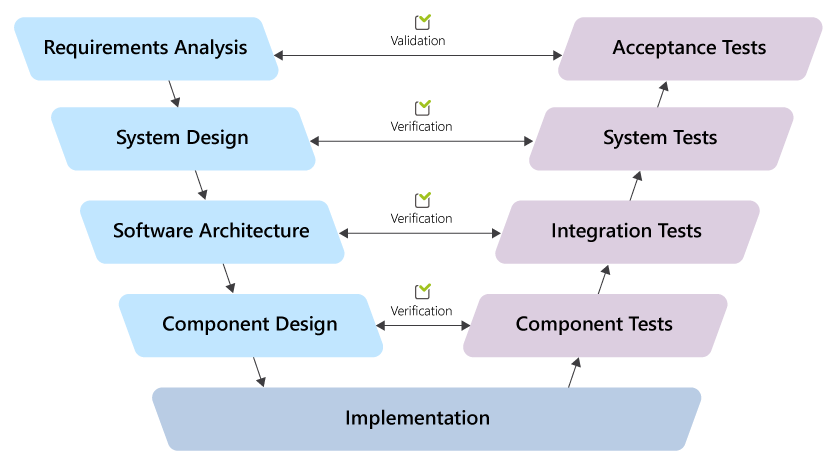
This drawback led to the evolution of the waterfall approach into the V-model. While the waterfall model merely describes the flow of activities, the V-model places quality assurance at the center of project management. The model “folds” the linear process in the middle, forming a distinctive V-shape.
The logic of the two legs is as follows:
The V-model divides the project into two inseparably linked sides:
1. The left leg (specification): Here, the process moves from the general to the specific. In phases such as requirements definition, system design, and software architecture, the system’s functionality and structure are determined.
2. The right leg (verification and validation): Rather than waiting until the end of the project to perform testing, the product is checked step-by-step from the bottom up against the specifications on the left. Every level of planning has a corresponding test on the right side.
- Component tests: Test the smallest building blocks against the technical detailed design.
- Integration tests: Verify the interaction of components against the system architecture.
- System tests: Check the entire system against the functional requirements.
- Acceptance tests (validation): The cycle closes at the top level here. A final check is performed to determine if the system meets the user’s original expectations. “Did we build the right system for the customer?”
Why the V-Model Reduces Risks
The key advantage of this model is the ability to plan tests early on. As requirements are defined on the left, corresponding test concepts are developed on the right. This prevents logical gaps in the planning process from being discovered shortly before delivery, when corrections would be costly and time-consuming.
The German Standard: V-Model XT
The V-Model XT, which was developed in Germany, is the logical evolution of the V-model for complex IT projects. The “XT” stands for “extreme tailoring.” Unlike rigid models, the V-Modell XT allows precise adaptation to the size and type of each project. This makes the V-Modell XT suitable for medium-sized projects without compromising audit compliance.
Rigidity and lack of perspective
Traditional projects often fail due to a lack of transparency regarding the critical path, or because plans are outdated and manually maintained in Excel. Often, delays in meeting deadlines are detected too late.
Planning Rigidity
In traditional projects, late changes to the requirements specification often lead to massive budget overruns because the dependencies in the Gantt chart are virtually impossible to manage manually.
Automated Planning
With objectiF RPM or in-STEP BLUE which are specifically designed for V-Modell XT, you can map the entire project lifecycle. Artifacts, such as requirements specifications and test reports, are generated directly from the process.
Compliant Management
With in-STEP BLUE, you can implement standards such as the V-Model XT right out of the box. The tool automatically generates artifacts and ensures that all milestones are met.

Integrated Compliance
In-STEP BLUE provides pre-built templates and workflows to support V-Modell XT projects and ensure that all regulatory requirements are met without any extra effort.
FAQ
Is traditional project management outdated?
No, it remains essential in industries with high safety and compliance requirements (e.g., automotive and medical technology) due to its structured approach and comprehensive documentation.
What is the biggest advantage of the V-Model over Waterfall?
Early test planning. In the V-model, the testing approach is defined as early as the design phase. This significantly reduces the cost of defects compared to the traditional waterfall model.
When should I choose traditional over agile project management?
Choose traditional methods when the requirements are clearly defined from the outset, when there are regulatory requirements that demand high documentation standards, or when the budget is fixed (the Magic Triangle).
Can traditional and agile approaches be combined?
Yes, this is called hybrid project management. With this approach, high-level phase planning is usually done with a traditional (waterfall) methodology, while implementation within teams uses an agile (Scrum) methodology.
Does objectiF RPM support traditional phases?
Yes. Although in-STEP BLUE specializes in the V-Model XT, objectiF RPM supports hybrid approaches combining traditional milestones and agile sprints.
Want to Know More?
Explore more knowledge base articles online or download one of our whitepapers.
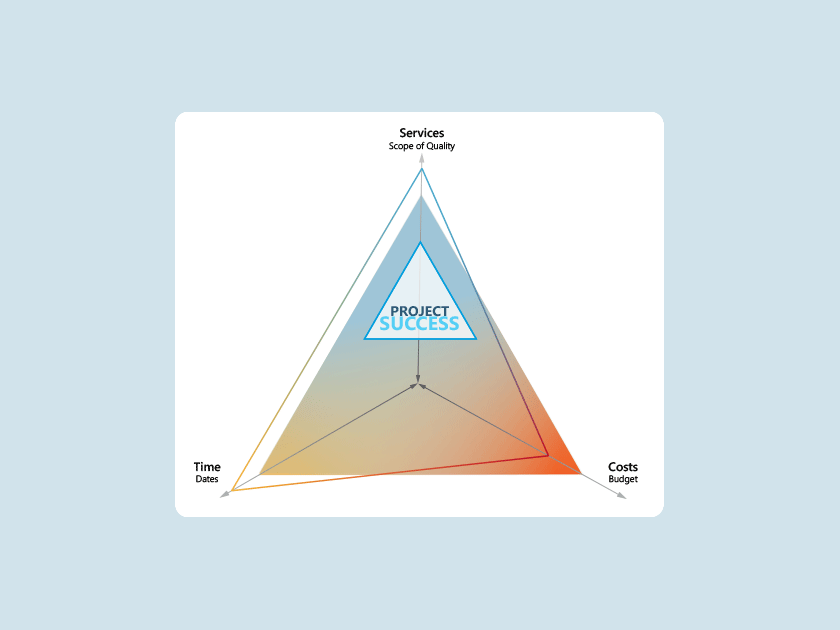
What is the Triple Constraint?
The triple constraint represents the three key success factors of a project: time, cost and scope. If one of these factors changes, it inevitably affects at least one of the other two. Project management therefore means continuously balancing these factors and addressing conflicting objectives at an early stage.
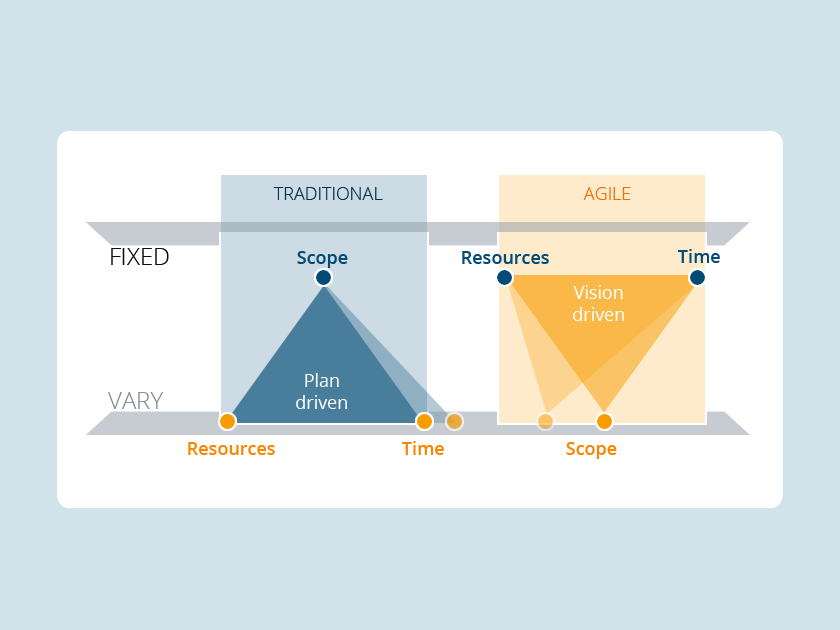
What is Agile Project Management?
Agile Project Management Explained: An Overview of Values, Methods, and Benefits—Including a Comparison to Traditional Approaches
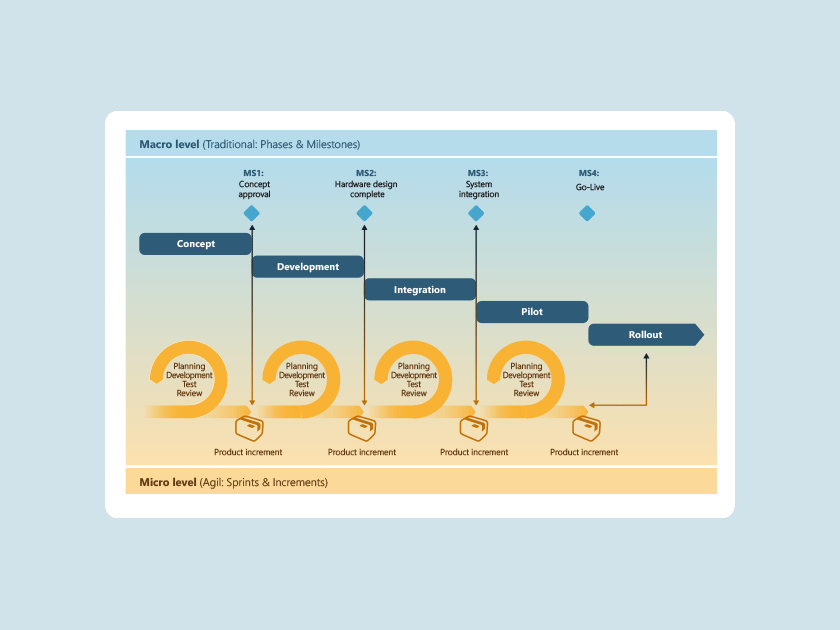
What is Hybrid Project Management?
Hybrid project management combines traditional planning with agile methods. This enables companies to maintain control over milestones, compliance and budgets while allowing teams to work flexibly and iteratively. With objectiF RPM, both approaches can be managed within a single, centralised platform.
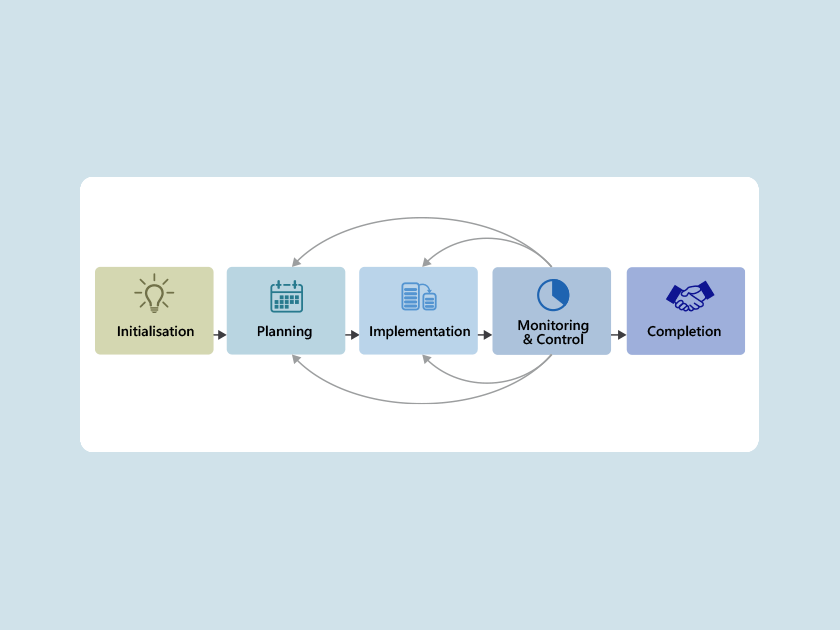
What is Project Management?
Project management provides structure, transparency, and planning certainty for complex projects. Using the right methods, clear processes, and centralized management, companies can balance time, budget, and quality, whether they use traditional, agile, or hybrid approaches.