

Project portfolio management (PPM) involves the centralized management of projects and programs to achieve strategic business objectives. While individual project management addresses the question, “Are we doing the project right?,” PPM focuses on the question, “Are we doing the right projects?” PPM optimally allocates limited resources to the most valuable initiatives and minimizes risks across the entire portfolio.
Standards and Guidelines: The Formal Framework for PPM
Project portfolio management (PPM) is not a one-time planning exercise, but rather a continuous process. It includes identifying, categorizing, evaluating, selecting, and prioritizing projects. The end goal is a balanced portfolio that strikes a balance between short- and long-term goals while also balancing risk and return. PPM follows internationally recognized standards and guidelines. They define terms, processes, and responsibilities, ensuring a common language among management, the PMO, and teams.
ISO 21508:2018 – The International Standard
ISO 21508 is the most important international standard for portfolio management. It provides guidelines for managing project portfolios and focuses on the following:
Strategic direction
How are projects selected to ensure alignment with the organization’s vision?
Realizing benefits
How can we ensure that our investments deliver the planned business value?
Governance
What decision-making authority do governing bodies such as the Portfolio Board have?
The PMI-Standard for Portfolio Management
The Project Management Institute (PMI) publishes one of the most practical standards, The Standard for Portfolio Management. It divides PPM into six knowledge areas:
- Strategic alignment
- Governance
- Portfolio performance
- Portfolio risk management
- Communications management
- Resource management
Strategic Alignment
Governance
Portfolio Performance
Portfolio Risk Management
Communications Management
Resource Management
DIN 69901-2 – The German Context
In Germany, the DIN 69901 series of standards, “Project Management — Project Management Systems,” is central. DIN 69901-2 is one of these standards. It defines project management processes and organizes them into a process model. This standard forms the basis for multiproject management and defines clear interfaces for how data from individual projects must flow into the overarching portfolio.
Distinguishing Between PPM and Multi-Project and Program Management
The terms program management, multi-project management, and project portfolio management are often used interchangeably. However, they describe different levels.
Program management
Group projects with related content together to achieve a common goal, such as developing a new series of aircraft.
Multi-project management
Focus on managing multiple concurrent projects and resolving resource conflicts.
Project portfolio management
This represents the highest strategic level. Decisions about which programs and projects to launch, halt, or postpone are made here, based on the company’s strategy.
Project portfolio management
This is the highest strategic level. Decisions about which programs and projects to launch, halt, or postpone are made here, based on the company’s strategy.
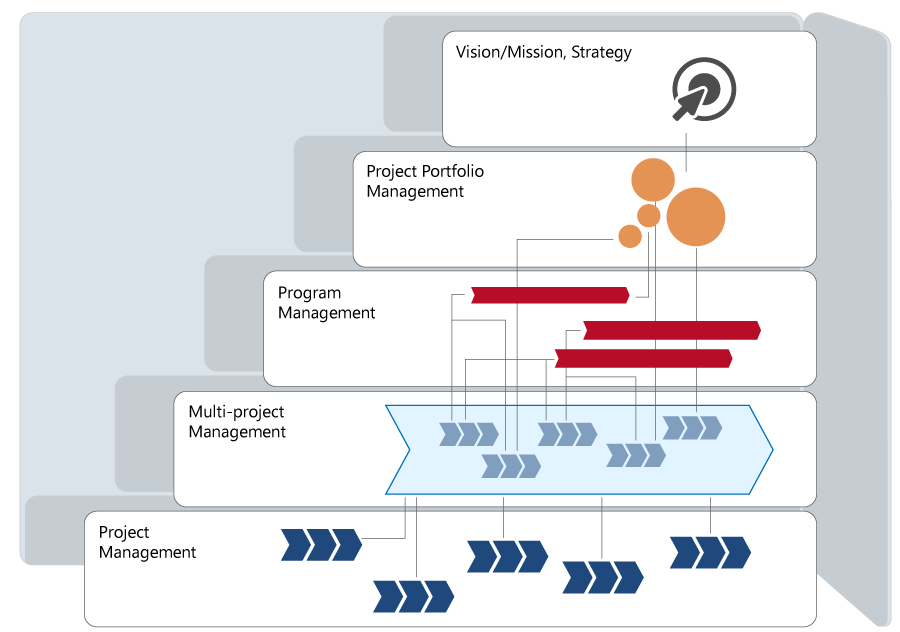
Project management is like a flight that takes passengers to a specific destination. Program management is like air traffic control, ensuring that air traffic runs smoothly. Portfolio management, on the other hand, is like operating an airport, which must run profitably and safely.
Agile and Lean Portfolio Management (LPM)
In organizations that have set agile transformation as their goal, traditional project portfolio management (PPM) is evolving into agile forms:
Agile Portfolio Management
It replaces rigid annual planning with rolling cycles at three levels:
- the operative level (uses Sprints of 1-4 weeks)
- the tactical level (uses Iterations of 2-3 month)
- the strategic level (uses goal definitions of 1-2 years)
All levels operate iteratively according to the Plan-Do-Check-Act (PDCA) cycle. Minimum viable products (MVPs) are used for market evaluation. Budgets are allocated more flexibly to enable a response to market changes.
Agile portfolio management:
- Is based on continuously aligning goals across all levels,
- requires measuring throughput across the entire company, e.g. via a company Kanban board with different flight levels,
- requires metrics such as NPV (Net Present Value, the value that can be achieved by completing an item while taking delay costs and interest effects into account), CoD (Cost of Delay, the costs that would arise from a delay), and WSJF (Weighted Shortest Job First, a relative assessment of which item generates the most value and feedback quickly),
- requires that work be assigned to the teams, rather than the other way around.
Lean Portfolio Management (LPM)
This approach is similar to those in frameworks such as the Scaled Agile Framework®, SAFe®. The focus here is on maximizing the value stream. Decisions are decentralized, and planning is based on hypotheses rather than rigid business cases.
Lean portfolio management differs from traditional project portfolio management in the following ways:
- Work is assigned to employees, not the other way around.
- Desired outcomes are defined, not the quantity of outcomes.
- “Value” is clearly defined and constantly redefined. Value creation is more important than cost control.
- Decisions and plans are reviewed retrospectively at fixed intervals based on feedback.
Budgets and funding can be adjusted flexibly in short cycles rather than being fixed annually.
Why is Project Portfolio Management Useful?
- Strategic alignment: Every project directly contributes to the company’s goals.
- Transparency: Provides an overview of all current and planned investments.
- Resource optimization: Avoiding overload through fact-based capacity planning.
- Risk management: Identifying dependencies between projects.
Core Tasks of Project Portfolio Management
PPM is a dynamic management process, not a static state. Portfolio management tasks can be divided into three phases: planning, management, and closure.
Phase 1: Planning, including Strategic Selection and Initiation
The most important task in the planning process is the filtering function, or “gatekeeping,” which ensures that only high-value projects are launched:
- Evaluation & Prioritization: Project proposals are reviewed based on opportunities, risks, and strategic importance to the organization. Then, they are approved or rejected.
- Initiation: Identify gaps in the portfolio and initiate new projects strategically to achieve strategic goals.
- Structuring: Grouping projects into hierarchical portfolios enables the separate management of different business units or product lines.
Phase 2: Operational Management and Coordination
Once the portfolio is active, the focus shifts to optimizing the entire system:
- Dependency analysis: This involves identifying and monitoring interactions between planned and ongoing projects (e.g., technological dependencies).
- Resource and synergy management: Coordinating resources across project boundaries to avoid conflicts and leverage synergies (e.g., the shared use of prototypes).
- Portfolio controlling: Continuously monitoring ongoing projects with regard to risks, resource utilization, and actual business value increases.
Phase 3: Closure and Knowledge Transfer
Project Portfolio Management (PPM) ensures long-term success, not just the conclusion of the project:
- Success Assessment: This involves evaluating completed projects to determine whether the promised benefits (business value) have actually been realized.
- Lessons Learned: Capturing insights from the portfolio to avoid future mistakes and make them available for use in future projects.
Case Study: Strategic Prioritization
Imagine a medium-sized company in the medical technology sector. Its specialized departments have limited capacity, yet 15 project proposals have been submitted for the next fiscal year, ranging from developing a new app to modernizing the production facility.
The PMO uses a scoring matrix to manage the portfolio objectively. Each project is evaluated based on four strategic criteria on a scale of 1 to 10:
- Strategic Fit: To what extent does the project contribute to the annual goal of “digitalization”?
- Cost-Effectiveness (ROI): How quickly will the investment costs be recouped?
- Urgency/Compliance: Are there legal deadlines (e.g., new EU regulations) that require the project to start?
- Risk: How likely are technical or personnel-related setbacks?
The Analysis: Portfolio Bubble Chart
The results are displayed in a bubble chart. The x-axis represents risk, the y-axis represents strategic benefit, and bubble size represents the required budget.
- Top Priority: Projects in the upper-left quadrant (high benefit, low risk) are launched immediately.
- Strategic Bets: Projects in the upper-right quadrant (high benefit, high risk) are closely monitored and assigned to experienced teams if necessary.
- Cancel/Postpone: Projects in the lower quadrants are consistently eliminated to free up resources for high-value initiatives.
From Spreadsheets to Strategic Project Management
“Flying blind” when it comes to prioritization:
It is unclear which project has the highest strategic value.
objectiF RPM allows you to evaluate projects based on strategic criteria using a weighted system. The result is an objective ranking of your portfolio.
Resource conflicts:
Teams are overloaded because too many projects are running simultaneously.
With objectiF RPM’s capacity planning feature, you can immediately identify when resources are fully utilized and reschedule projects in your portfolio.
Lack of transparency:
Management does not receive status reports on the entire portfolio that are up to date.
Automated portfolio dashboards offer real-time data on project costs, deadlines, and progress directly from the database.
Manual portfolio management:
Project evaluations and portfolio decisions based on outdated manual spreadsheets do not provide a comprehensive overview.
Instead of maintaining a laborious Excel scoring matrix, objectiF RPM offers automated workflows. As soon as a project proposal is evaluated, it appears on the portfolio dashboard. Management can immediately see the impact on overall capacity: For example, they might see, “If we start Project A, we’ll have to postpone Project B by three months.”

Align Every Project with Your Business Strategy
Do you know which projects will lead your business to success? With objectiF RPM, you can transform your business strategy into a measurable portfolio. Objectively evaluate potential, prioritize with foresight, and always keep an eye on ROI.
FAQ
Who is responsible for project portfolio management?
Typically, responsibility lies with either the portfolio board or a central project management office (PMO), which works closely with senior management.
What is a portfolio backlog?
In Agile portfolio management, the portfolio backlog is a central list of all strategic initiatives (epics) awaiting implementation.
How often should a project portfolio be evaluated?
Depending on its dynamics, a project portfolio should be evaluated either monthly or quarterly. In an agile environment, however, it should be evaluated on a rolling basis.
How are project portfolio management (PPM) and requirements engineering related?
PPM determines whether a product will be built, while requirements engineering defines exactly what will be built. Both must be synchronized to ensure a positive ROI.
Want to Know More?
Explore more knowledge base articles online or download one of our whitepapers.
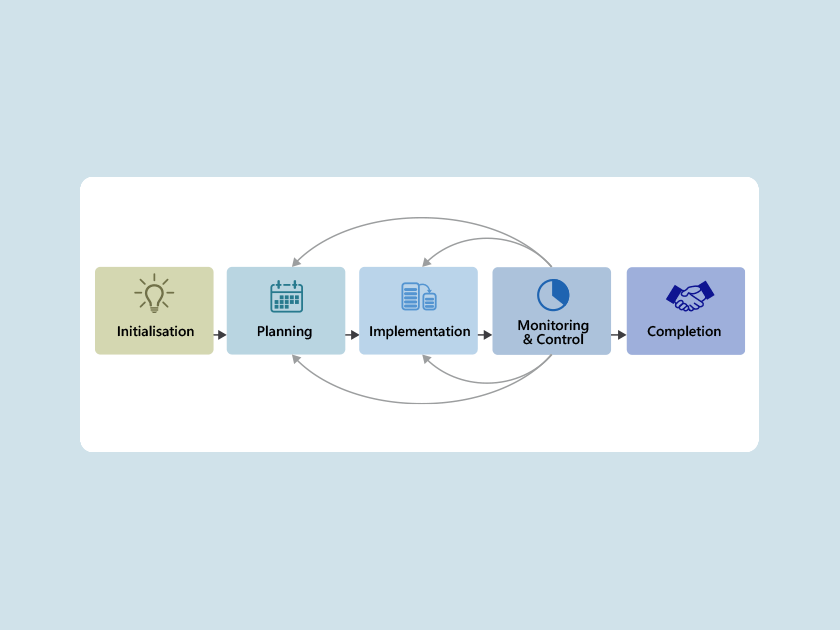
What is Project Management?
Project management provides structure, transparency, and planning certainty for complex projects. Using the right methods, clear processes, and centralized management, companies can balance time, budget, and quality, whether they use traditional, agile, or hybrid approaches.
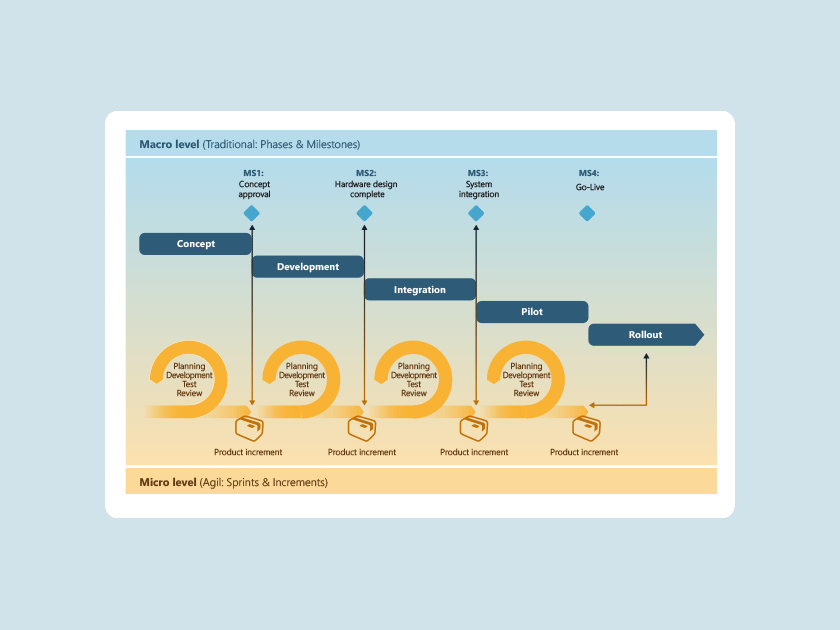
What is Hybrid Project Management?
Hybrid project management combines traditional planning with agile methods. This enables companies to maintain control over milestones, compliance and budgets while allowing teams to work flexibly and iteratively. With objectiF RPM, both approaches can be managed within a single, centralised platform.
objectiF RPM – Whitepaper
Increase your business agility. Get to know objectiF RPM in this whitepaper. From the needs of stakeholders to IT systems for successful business.
objectiF RM – Whitepaper
Requirements Engineering for Software and Systems. Read about benefits and options of objectiF RM in this whitepaper.