
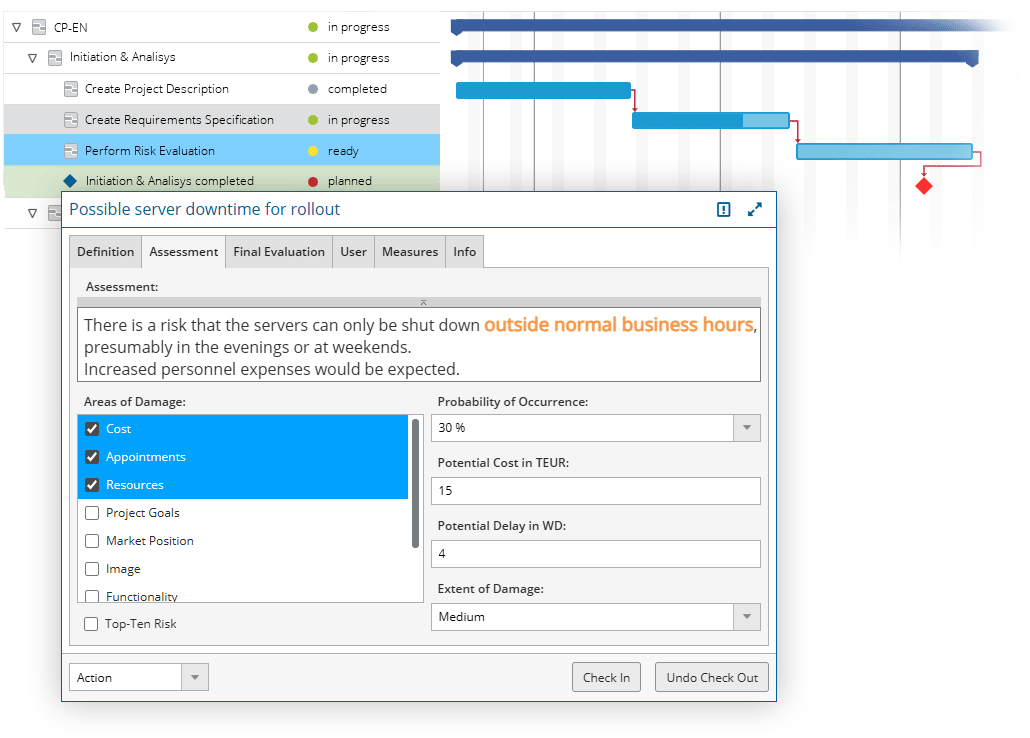
Combine risk management and project management by directly integrating work packages into your project plan.
Identify, manage and prioritize risks in order to minimize and control impacts of unfortunate events.
Design your individual risk management procedures including elements, gathered information and forms.
Customizable presets for risk categories minimize set-up time.
Fully tailorable risk management with in-STEP BLUE includes adjustable evaluations and personal notifications and alerts.

Risk management and project management in one single software.
Manage projects with processes.
What is Risk Management?
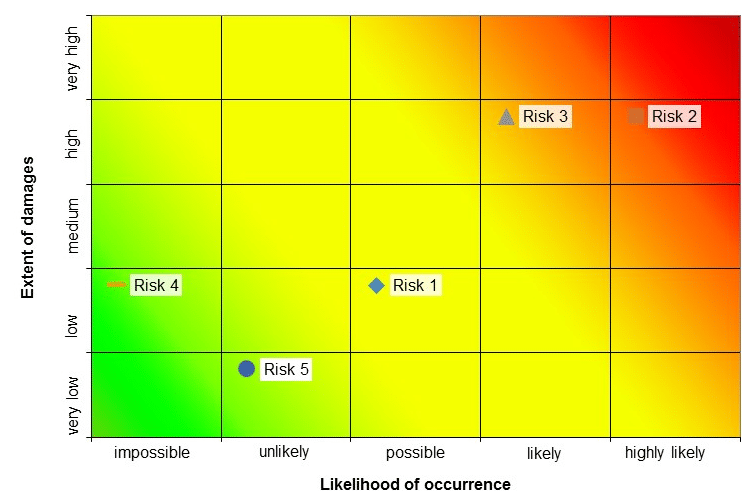
Which information do you need?
With in-STEP BLUE you manage your risks, requirements and entire projects in one single software. In real-time, and with no unnecessary interfaces. For increased transparency.
How does in-STEP BLUE support you?
Integrated risk management
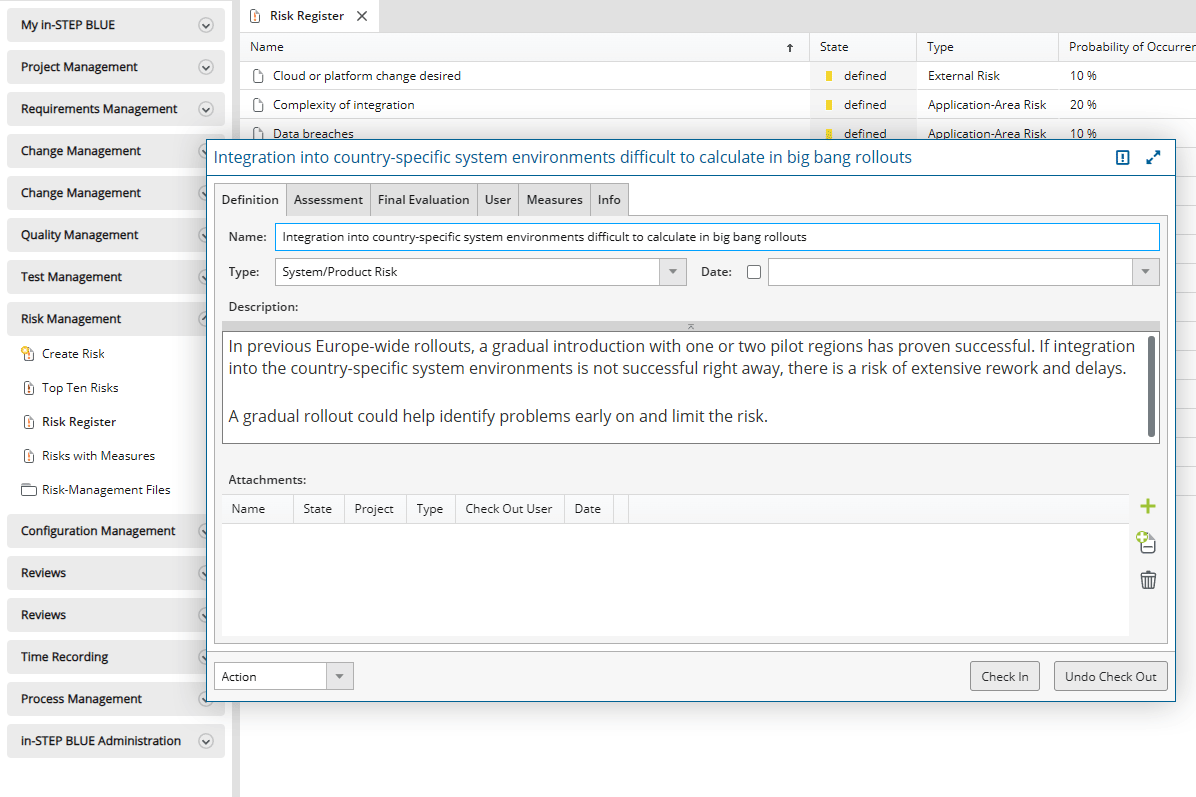
With in-STEP BLUE, you can record risks easily and in a structured manner using forms. The forms are preconfigured but can be modified in terms of form and content. The advantage of formal recording is obvious: all information relating to a specific risk can be found in one central location.
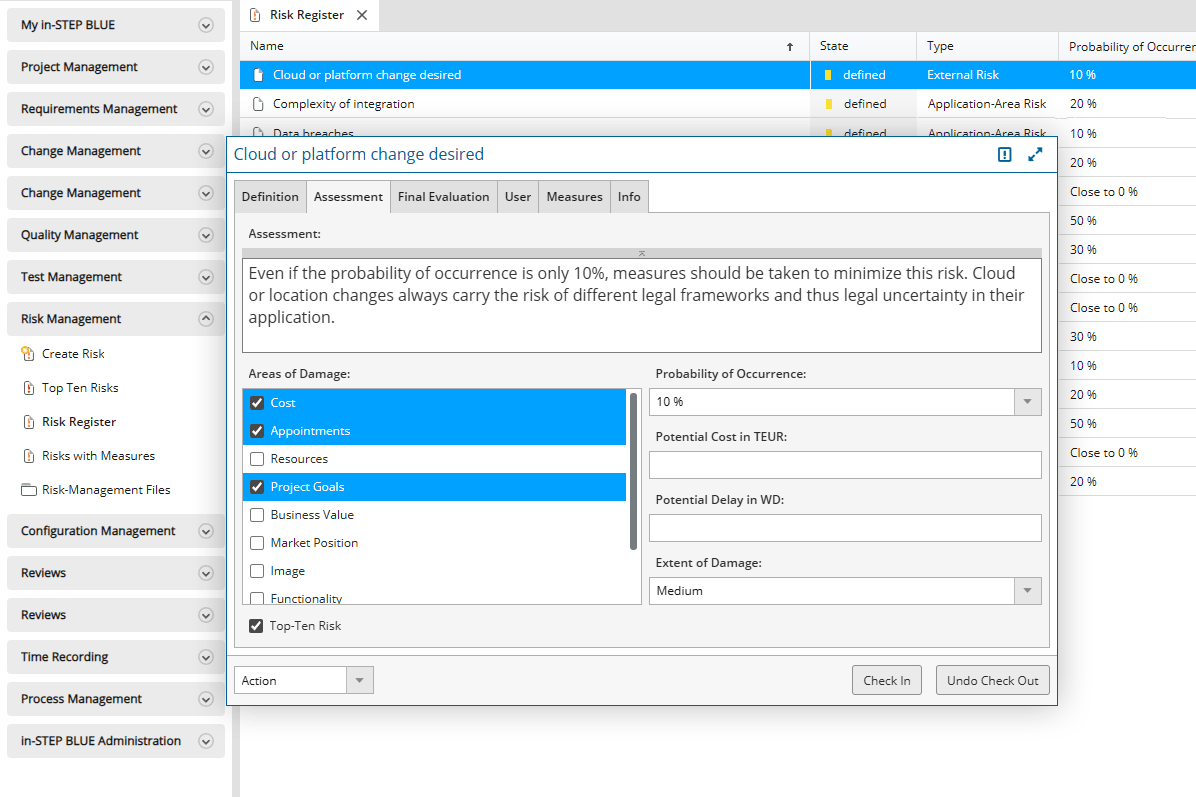
Of course, risks must be assessed. If it is a top ten risk, how great is the expected damage, how likely is it to occur, which category does the risk fall into, etc.?
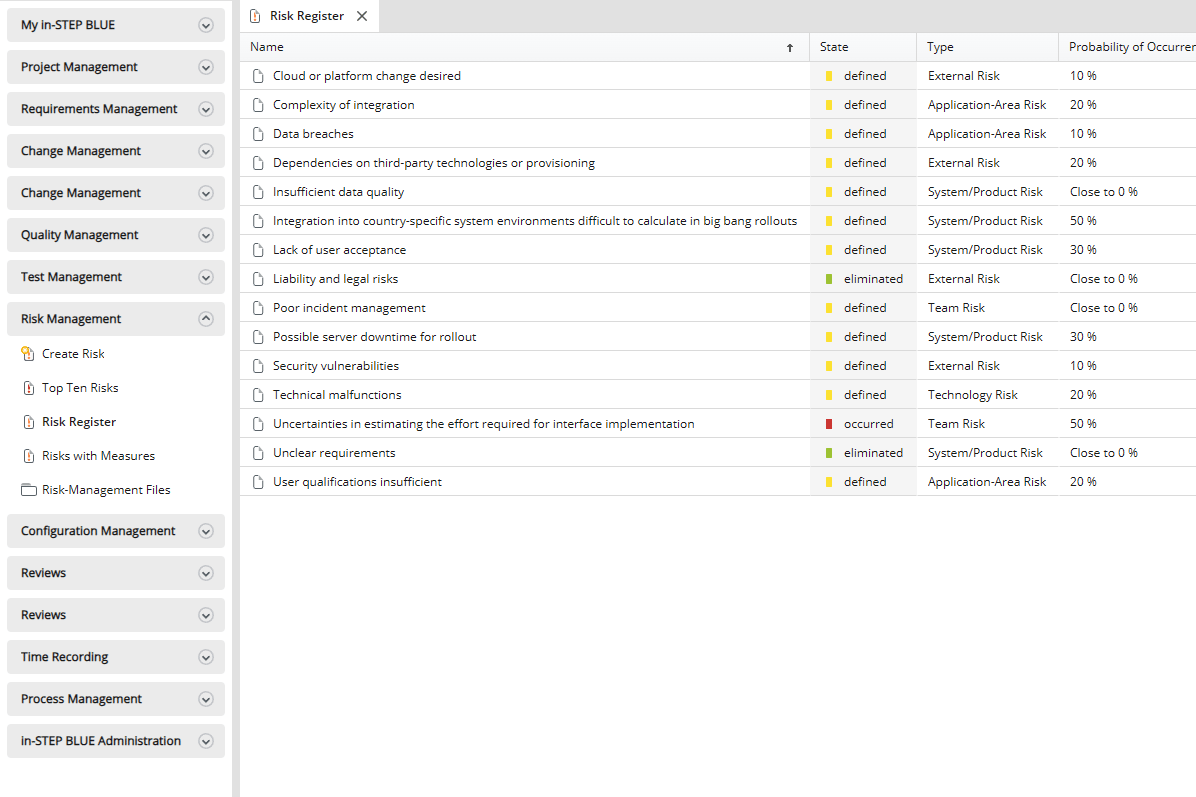
You can easily view the characteristics of the risks in the project’s risk register. Of course, you can decide for yourself which characteristics of the risks you want to display here.
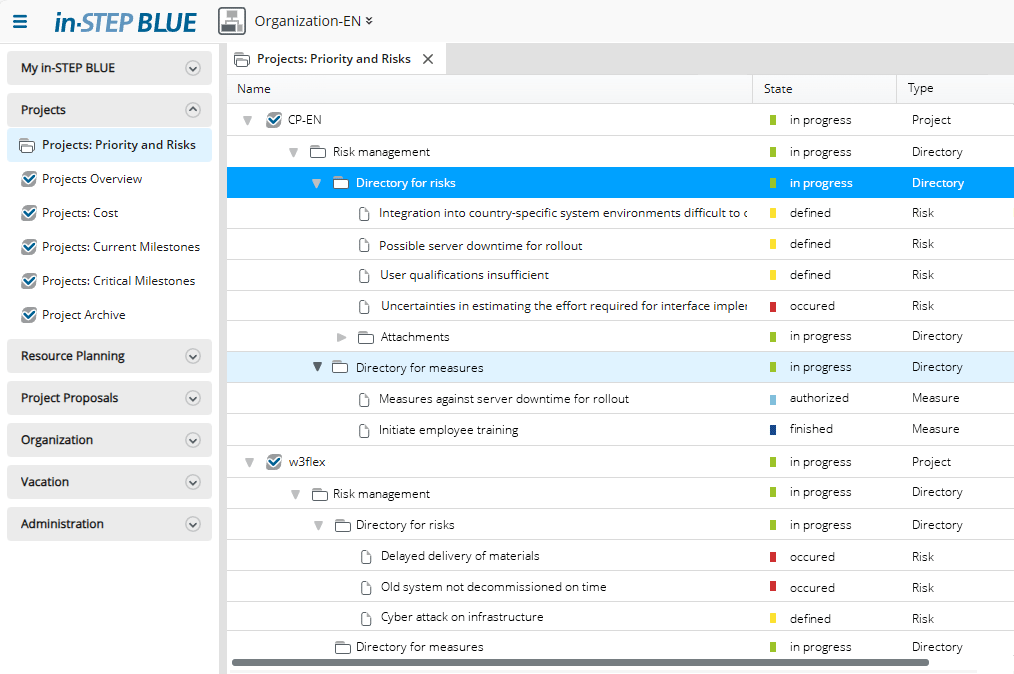
Risks can also be displayed at the organizational level. You can also define central risk management in in-STEP BLUE and then derive measures for individual projects. in-STEP BLUE is your software and it is your process for dealing with risks.
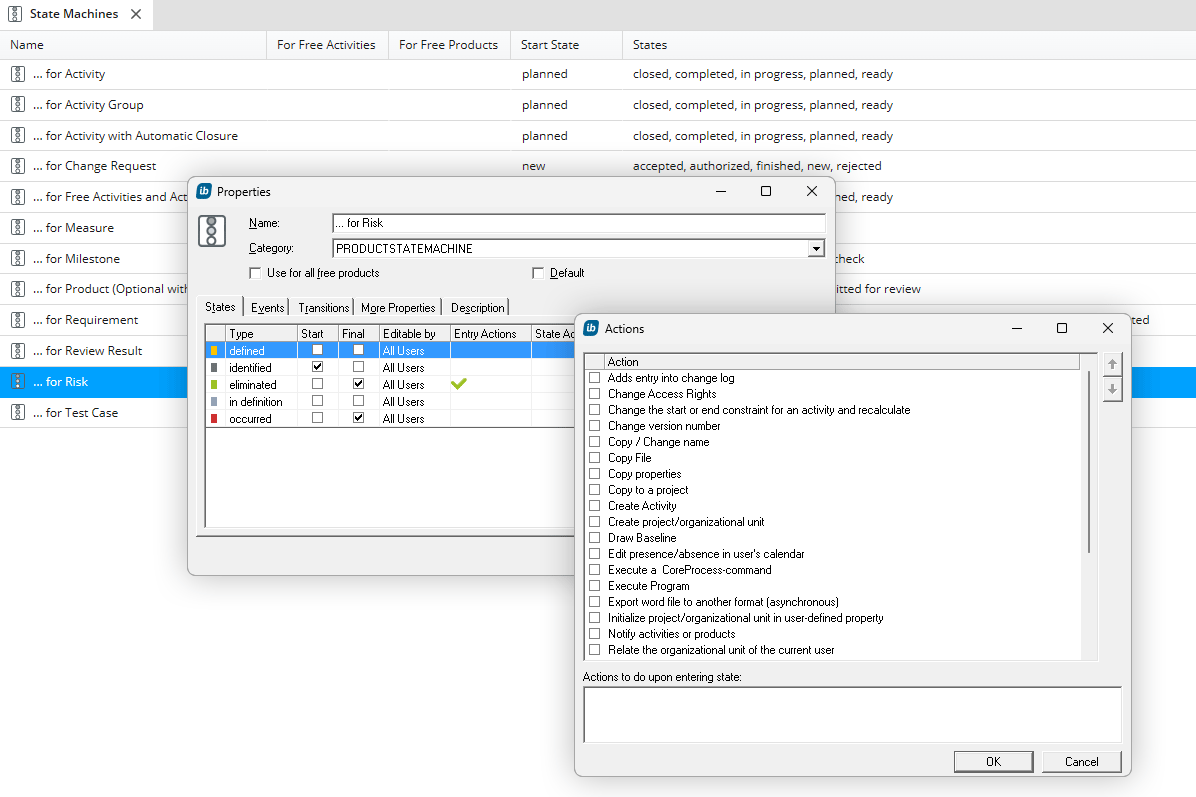
Want to trigger actions automatically when state transitions occur? No problem—just define the actions in the state machine for the respective transition.
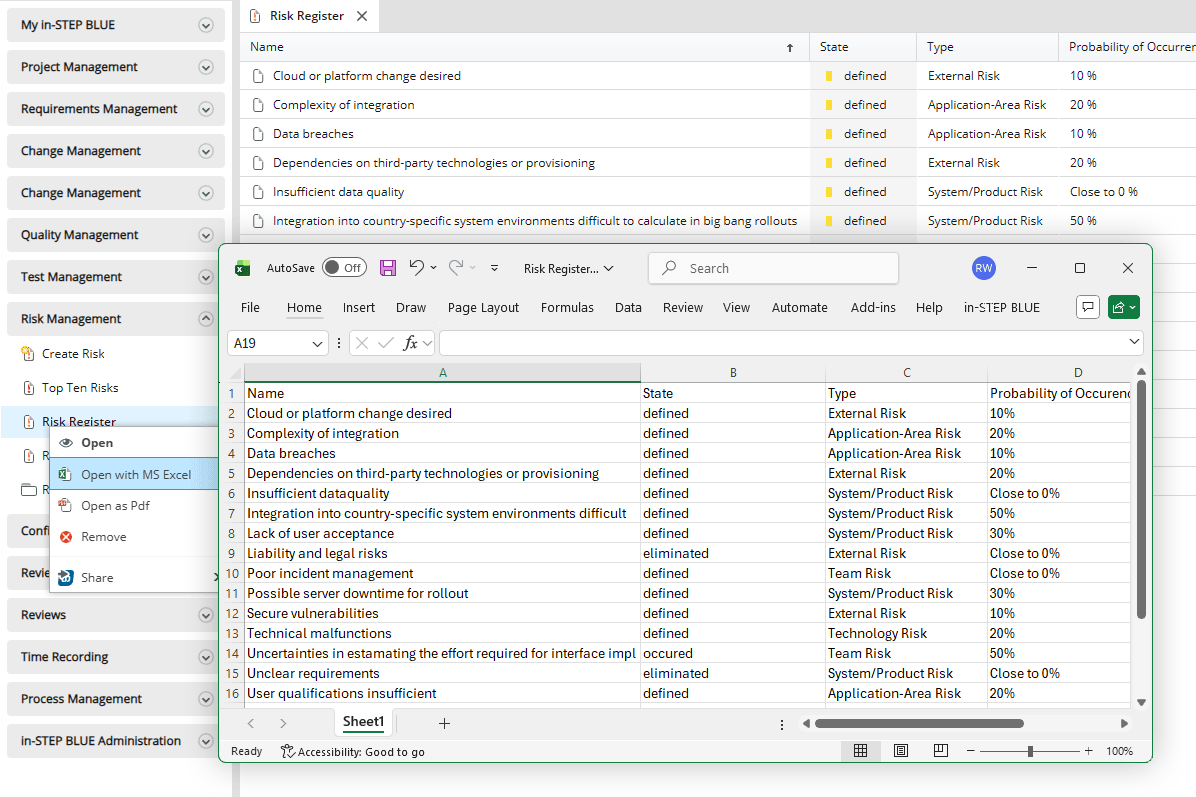
What do you do if you want to export information from in-STEP BLUE? Then you export the information, e.g., to MS Excel or as an XML file, etc. One click is all it takes.
Click here for a list of features of risk management with in-STEP BLUE
- Identify, categorize, evaluate and prioritize risks.
- Define custom attributes for risk management.
- Control the probability of unfortunate events and determine potential costs and delays.
- Plan measures for risk avoidance, risk minimization, shifting and acceptance.
- Control and monitor risks and measures.
- Define responsibilities.
- Create risk indexes with references to artefacts.
- Generate standardized reports at the click of a mouse.
- Ensure complete traceability of risk management procedures.
- Define individual procedures for risk management in your organization.
- Create a risk library with references and connections to artefacts.
- Define roles for specific tasks in your projects and in your organization.
- Use check lists and templates for easy operations and faster project set-up and launch.
- Enable effective communication about risks in a common system.
- Include quantitative analyses in your business plan.
- Guarantee compliance for all risk-related measures.
- Determine technical risks as well as personal risks.
- Utilize key figures as well as diagrams in reports.
- Establish risk categories for effective evaluation.
- Facilitate early communication about mistakes.
- Implement your own concepts and methods in a tool.
- Elicit risks online or on-site and create powerful visualizations.
- Make risk identification an integral part of your project and multi-project management.
- Adhere to norm and guidelines with the help of a tool.
- Combine risk control and risk acceptance.
- Create annual reports at the click of a mouse.
- Export to Word, Excel, PDF, HTML and XML.
Try out free of charge
Request a free trial of in-STEP BLUE now.
Tips & Tricks
In our Download Center you will find even more interesting downloads for in-STEP BLUE.

What users say about in-STEP BLUE
“After having successfully used objectiF as part of our software development projects in the past, we decided to manage our development projects with in-STEP a few years ago. We now have an even tighter grip on documentation as well as on date control and cost planning!“