

Many teams are familiar with this scenario. At the beginning of the year or quarter, ambitious company goals are established. The direction and motivation are both right. But a few weeks later, the crucial question arises: How can we tell if we’re actually getting closer to our goal? One answer is the OKR method, which you can use with our dedicated OKR project template. This template is special because it includes two preconfigured AI assistants. In this post, as part of our blog series on AI assistants in objectiF RPM, we’ll take a closer look at them using the example of “Improving the Product and Customer Experience.”
OKR Requires Clarity on Two Levels
OKR stands for “Objectives and Key Results” and is an agile framework for managing goals that links strategic objectives with measurable outcomes. Objectives set the direction, while key results make progress measurable. The major advantage is that: OKR fosters focus, alignment, and transparency. Rather than relying on rigid annual plans, the method thrives on short cycles. You can find more information about OKR on our knowledge page. However, the challenge lies in translating goals into operational work consistently. OKR can fail due to isolated tools, high maintenance requirements, and a lack of structure. The OKR project template in objectiF RPM helps you clearly link objectives, key results, and the tasks derived from them.
Define Key Results for Objectives
The AI assistant, “Define key results for objectives,” addresses the common question, “How will we actually know we’re making progress?” It takes a previously selected objective as its starting point and generates appropriate key results based on it. This transforms a qualitative goal into a measurable framework.
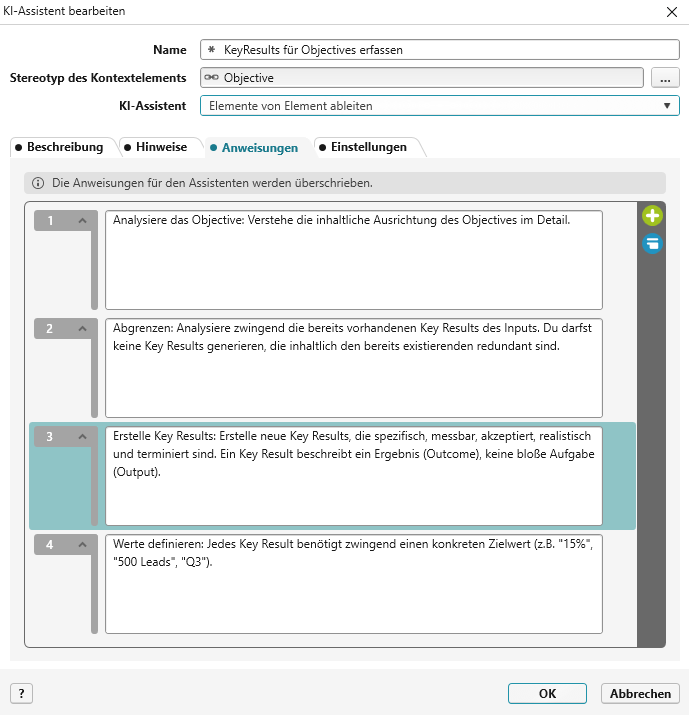
You can always edit the AI assistant’s settings later, such as the instructions shown here.
Since the AI assistants have already been configured, you can start using them right away. However, you can still adjust the settings to tailor the assistant to your exact needs.
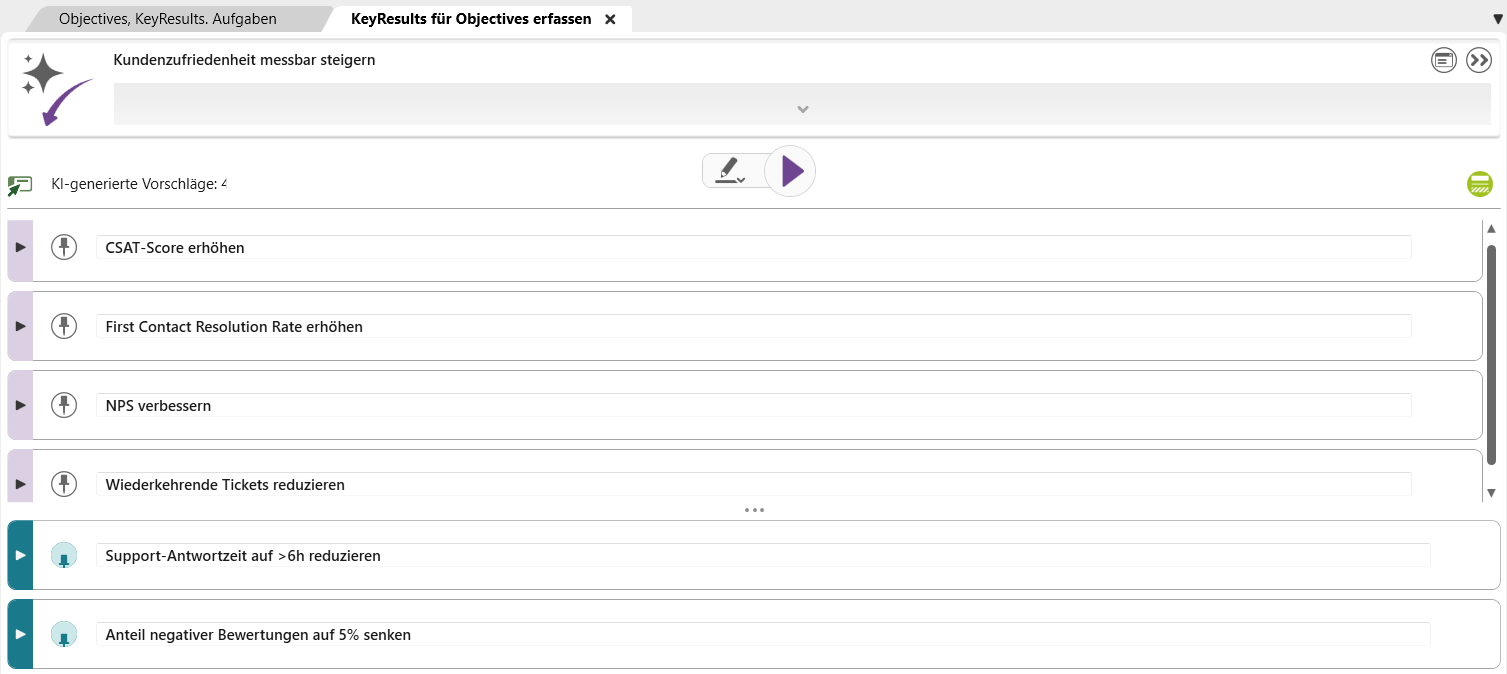 In the OKR method, key results are measurable outcomes designed to track progress. In practice, the assistant helps transform an inspiring goal into concrete success metrics. In our example, this could mean reducing recurring tickets to help achieve the objective of “measurably increasing customer satisfaction.” Thus, the assistant helps with both the formulation and the thinking process. What specifically needs to change for the objective to be considered achieved? Which metric shows progress? The assistant provides a structured starting point for this that the team can refine technically.
Define Tasks for Key Results
Once the key result has been defined, the second AI assistant, “Define tasks for key results,” can help with the next step. It translates the measurable result into concrete work steps that the team can use to achieve the key result. This significantly shortens the gap between strategy and implementation.
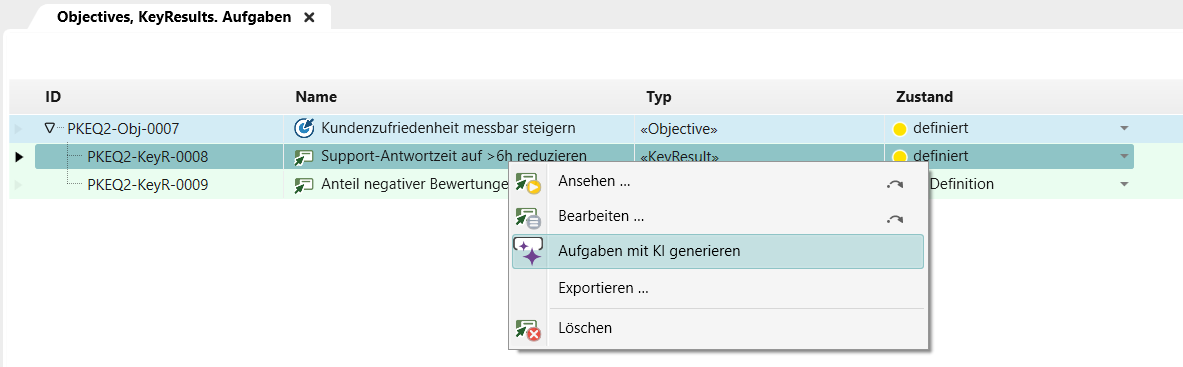 This is the operational lever that many OKR implementations desperately need. After all, OKRs shouldn’t just define goals. This method is most effective when goals are actively pursued on a quarterly basis, progress is regularly reviewed, and the connection to concrete implementation is maintained. This is precisely where the assistant comes in, creating a meaningful initial set of tasks from a key result.
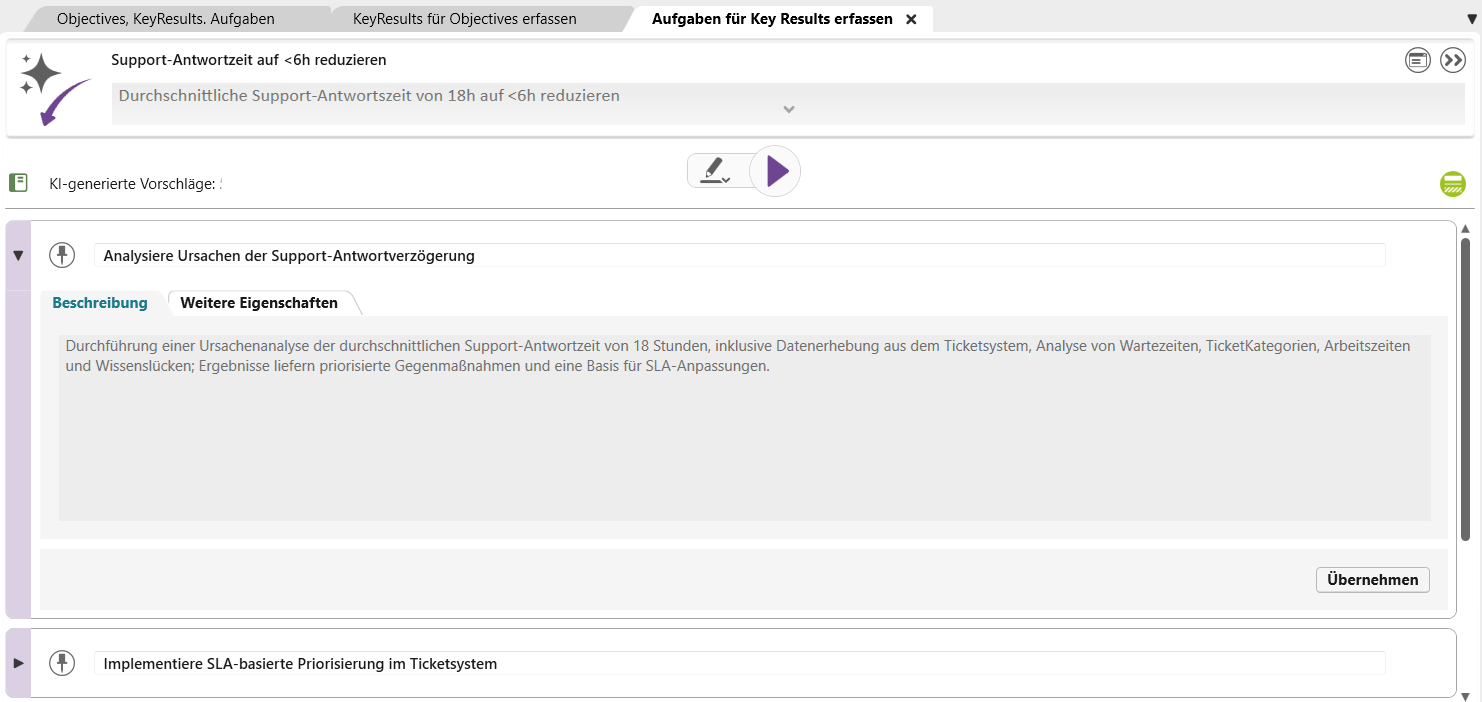 Your team will receive a structured proposal that they can use to prioritize, expand upon, and adapt. For the key result “Reduce support response time to six hours,” the assistant suggests conducting a detailed root cause analysis using data from the ticket system. This analysis would focus specifically on wait times, ticket categories, working hours, and knowledge gaps. The AI provides a productive proposal that accelerates operational planning while maintaining human involvement. This saves time and maintains focus on the actual goal.
Conclusion
The two wizards form a clear chain together: from objective to key result and from key result to task. In this way, ObjectiF RPM optimally supports the typical OKR process of translating strategy into implementation. A major benefit is that they overcome the initial challenge of a blank field or unclear derivation.
With the provided assistants, an objective becomes a robust pool of suggestions for key results, which then become a concrete work plan. Both assistants ensure that OKR works in day-to-day project management, not just sounds good.
Try our new OKR project template with AI assistants at any time in the objectiF RPM template catalog (version 9.4 and up) to help you achieve your next goals.