
The Certified Professional for Requirements Engineering (CPRE) certification is a globally recognized standard for training and education in requirements engineering. Awarded by the IREB (International Requirements Engineering Board), the certification confirms that professionals possess comprehensive, standardized knowledge in eliciting, documenting, and managing requirements. The certification program has three levels: Foundation, Advanced, and Expert.
Core Concepts of CPRE
The CPRE curriculum is based on unified terminology and a methodology-independent syllabus. The goal is to establish a “common language” among requirements engineers, system developers, testers, and other stakeholders to minimize misunderstandings in projects. Particular emphasis is placed on the practical application of Requirements Engineering Principles.
Certification Levels
The CPRE certification program is modular, providing the right qualifications for every stage of your career:
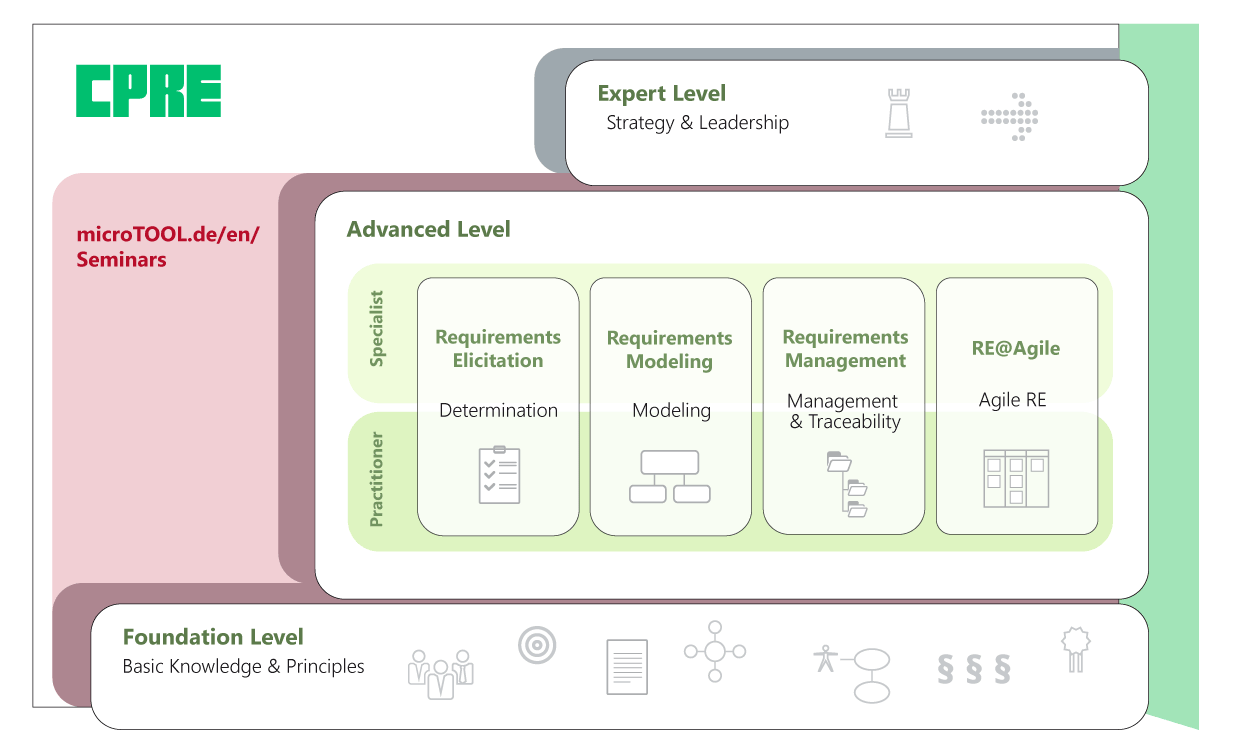
Foundation Level
This level establishes the foundation for all subsequent certifications. It covers the fundamentals. What is the System context? How do you conduct a Stakeholder analysis? How do you professionally document requirements? This level is ideal for beginners and all project participants.
Advanced Level
The advanced level is designed for specialists looking to deepen their knowledge. Various modules are available, including:
- Requirements Elicitation: Advanced Elicitation Techniques
- Requirements Modeling: Graphical Modeling (e.g., UML or SysML)
- Requirements Management: Focus on Traceability and Change control
- RE@Agile: RE in agile environments, such as Scrum.
Expert Level
The highest level for experienced professionals. The focus is on strategically shaping RE processes within organizations.
CPRE vs. Other Certifications
| CPRE (IREB) | CBAP (IIBA) | PMI-PBA (PMI) | |
|---|---|---|---|
| Publisher | Foundation: fundamental truth or principle | Tool: Systematic sequence of actions | Tool: Systematic sequence of actions |
| Core focus | Requirements Engineering (specialist knowledge) | Business Analysis (generalist knowledge) | Business analysis in a project management context |
| Methododology |
Methodically functional, highly technical & system-focused |
Process-oriented according to BABOK (Business Analysis Body of Knowledge) | Focus on project interfaces and stakeholders |
| Level model | Foundation, Advanced, Expert | Multiple levels (ECBA, CCBA, CBAP) | Specialized certification alongside PMP |
| Target audience | Requirements Engineers, System Analysts, Product Owner | Business Analysts, Consultants | Projekt Managers with BA responsibility |
| Geographic Focus |
Market leader in Europe & DACH, growing worldwide |
Strong in North America, Australia, UK | Globally established (PMI network) |
| Prerequisites |
None for Foundation; Advanced requires FL |
Proof of at least 7.500 hours of BA experience | Proof of project experience and BA hours |
CPRE for Project Success
Projects rarely fail due to technology; they fail because of unclear requirements. Without solid requirements engineering expertise, business departments and technical teams are unable to communicate effectively with each other. The consequences are well known: endless change requests, escalating costs, disgruntled stakeholders, and significant delays in time-to-market.
microTOOL is more than just a software provider; it has been an accredited IREB training provider for years. Our trainers are experienced Requirements Engineering (RE) consultants who understand project challenges from long-term practical experience—insights that are also built into our tools. We train your employees to act as translators between business and technology. Our CPRE training is not theoretical or rote memorization; it is hands-on preparation for project success.
CPRE Certification According to IREB
Our 3-day CPRE seminars for the Foundation and Advanced levels combine methodological competence with practical relevance.
FAQ
How long is the CPRE certification valid?
The Foundation Level certificate is valid indefinitely and does not need to be renewed.
Is CPRE also useful for agile teams?
Yes. IREB has established a standard with the “RE@Agile” module that demonstrates how requirements engineering works in agile contexts.
What are the prerequisites for the exam?
There are no formal prerequisites for the Foundation Level. However, experience in IT or system development is recommended.
Is the exam difficult?
A solid understanding of the IREB syllabus is required for the exam. Targeted preparation with a training provider such as microTOOL is strongly recommended.
Do You Want to Know More?
Explore more knowledge base articles online or download one of our whitepapers.
IREB CPRE Advanced Level Online
In the CPRE Advanced Level online seminar you will learn more about techniques and methods for requirements management, modeling or elicitation.
Next dates:
04/07/ – 04/09/2026 Elicitation
05/27/ – 05/29/2026 Management
07/07/ – 07/09/2026 Modeling

IREB CPRE Foundation Level Online
In the three-day CPRE Foundation Level online seminar, you will learn the basic knowledge of requirements engineering, as well as methods and techniques of requirements analysis and requirements management.
Next dates:
03/23/ – 03/25/2026
04/20/ – 04/22/2026
05/19/ – 05/21/2026
06/15/ – 06/17/2026
What is Requirements Engineering?
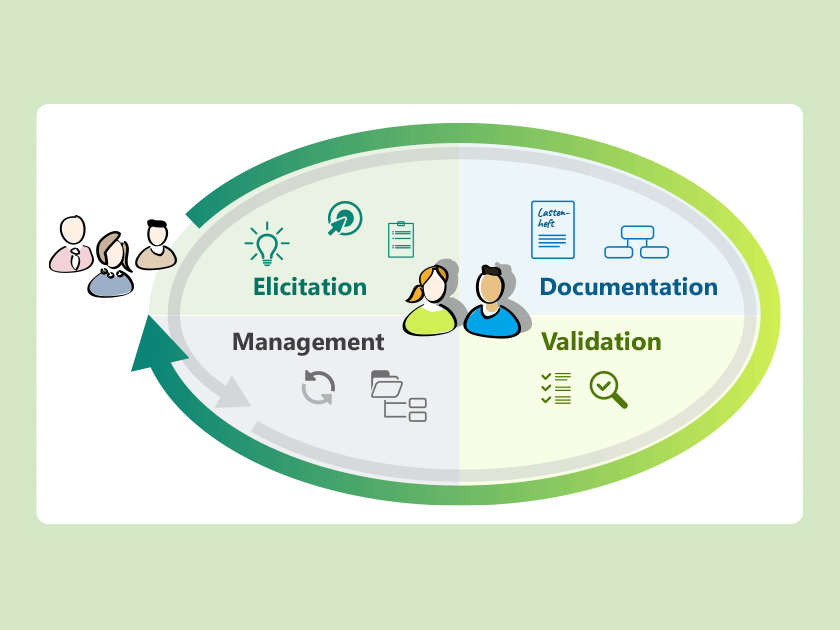
Requirements engineering (RE) involves eliciting, documenting, validating, and managing requirements. Learn how professional RE can safeguard your projects.