

The Critical Path is the longest consecutive series of activities in a project plan. It determines the shortest possible total project duration. What makes the critical path unique is that the activities on this path have no time buffer. If any of these activities are delayed, the entire project will be delayed as well.
Why Is the Critical Path Called “Critical”?
Here, the term “critical” does not refer to a risk of error, but rather to time constraints.
- No scheduling flexibility: While other tasks in the project can “breathe” (i.e., they can start later or take longer), the critical path represents the time bottleneck.
- Schedule reliability: It is the sequence or one of the sequences of activities that determines the project completion date. Anyone who does not know the critical path is managing their project blindly with regard to the delivery date.
How Can You Identify the Critical Path?
The critical path can be identified in the project schedule (Gantt chart or network diagram) by the following technical characteristics:
- Total float = 0: In an unconstrained CPM schedule, activities on the critical path typically have zero total float. Constraints may result in positive or negative float. There is no slack between the earliest possible finish date and the latest allowable finish date.
- Matching Dates: The Earliest Start (ES) and Latest Start (LS) are identical.
- Visual Highlighting: In professional project management software, the critical path is usually highlighted in red to distinguish it from the blue (noncritical) tasks.
How Does the Critical Path Method (CPM) Work?
The Critical Path Method (CPM) is a mathematical analysis of a network diagram. Two calculation steps are performed to identify the critical path:
Forward Pass
This determines the earliest possible start and finish dates for each activity.
Backward Pass
It determines the latest possible start and finish dates without delaying project completion.
The critical path consists of all activities where the earliest and latest dates are identical.
The Importance of Float
A key concept in CPM is float. There are two types:
- Total Float: The amount of time an activity can be delayed without affecting the project’s completion date. It is calculated as follows:
Total float = LS – ES
or
Total float = LF – EF
(LS= Latest Start, ES = Earliest Start; LF = Latest Finish, EF = Earliest Finish)
- Free Float: The amount of time an activity can be delayed without affecting the earliest start of any subsequent activity.
What Is the Critical Path Used For?
Identifying the critical path is much more than just a scheduling exercise; it is a powerful project management tool:
- Focus: Project managers can immediately identify which activities require their full attention.
- Resource Optimization: Resources are prioritized for activities on the critical path. Activities with significant float offer greater flexibility for reallocating resources.
- Schedule Compression (Crashing): Accelerating random activities will not help if a project must be completed sooner. To reduce the overall project duration, activities on the current critical path must be shortened; the critical path may change as a result.
- Risk Management: The critical path highlights where the risk of schedule delays is greatest.
Why the Critical Path Matters for Risk Management
The critical path serves as an early warning system for project managers. Since activities on this path have no scheduling flexibility, they require the closest monitoring. When resources become limited, they should first be allocated to activities on the critical path. Tasks outside the critical path provide scheduling flexibility through their available float, allowing teams to respond more effectively to unexpected events.
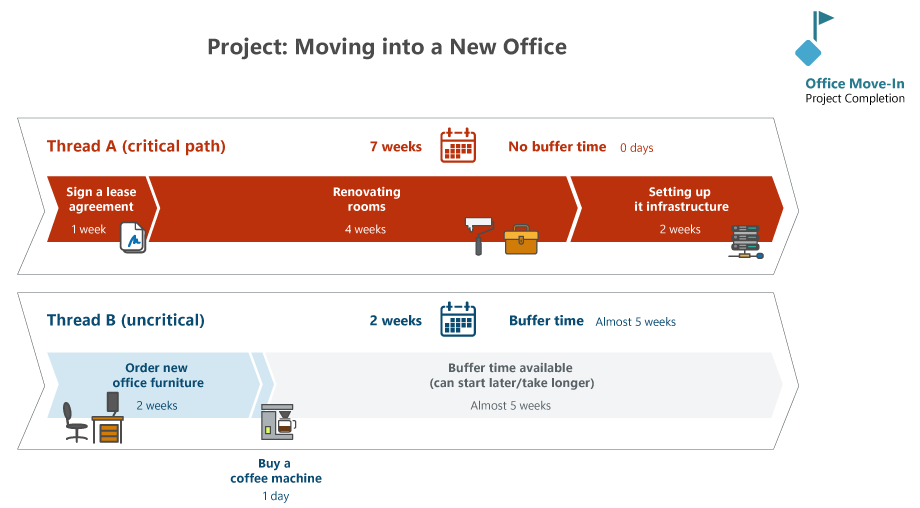
A Basic Example: Moving into a New Office
Sequence A (the critical path)
- Sign the lease agreement (1 week)
- Renovate the office (4 weeks)
- Set up the IT infrastructure (2 weeks)
→ Total duration: 7 weeks
Sequence B (runs in parallel)
- Order new office furniture (2-week delivery)
- Buy a coffee machine (1 day)
→ Total duration: approximately two weeks
Analysis
Sequence A is the critical path. Each activity depends on the previous one. For example, you cannot renovate the office before signing the lease. If the renovation takes an additional week, the move-in date will be delayed by one week.
If the coffee machine arrives three weeks late, it will be inconvenient, but it will not affect the move-in date because Sequence B has approximately five weeks of float.
The Critical Path in Agile and Hybrid Environments
In purely Agile frameworks, such as Scrum, the traditional Critical Path is rarely calculated because planning is done in short iterations. In hybrid project management, however, the critical path can remain particularly useful for long-term scheduling. The long-term roadmap is often managed using CPM, while execution within individual phases follows agile practices.
Precision Instead of Estimation
Manual errors
In complex projects with hundreds of dependencies, manual calculation becomes increasingly time-consuming and error-prone.
in-STEP BLUE automatically calculates the critical path based on your network logic and highlights it in the Gantt chart, typically in red.
Limited visibility
Without dedicated software, it is often unclear which delays are truly critical and which are protected by available float.
With in-STEP BLUE you can immediately see how schedule changes affect the entire project portfolio. The software graphically shows where float is being consumed.
Resource bottlenecks
While the critical path may be clear from a scheduling perspective, the required team members may already be committed to other projects.
Our tool combines CPM with resource management. With this tool, you can see which activities are time-critical and whether the necessary experts are available.

Make risks visible before they stop your project.
Delays on the critical path leave no room for error. With in-STEP BLUE, you can identify bottlenecks before they become serious problems. Use automated network scheduling to manage float effectively and keep your project deadlines on track for customers and management.
FAQ
Can there be more than one critical path?
Yes, if multiple sequences of activities have the same total duration and zero float, then a project can have multiple parallel critical paths. This significantly increases project risk because delays in any of these paths will delay the entire project.
What is the difference between the critical path and the critical chain?
The Critical Path Method (CPM) focuses solely on the logical sequence and timing of project activities. The Critical Chain Method (CCM), on the other hand, takes resource constraints into account and uses project-level buffers instead of assigning buffer time to individual activities.
Can the Critical Path change during a project?
Yes. If activities outside the Critical Path are delayed enough to consume all of their available float, they can become part of a new Critical Path.
Do You Want to Know More?
Explore more knowledge base articles online or download one of our whitepapers.
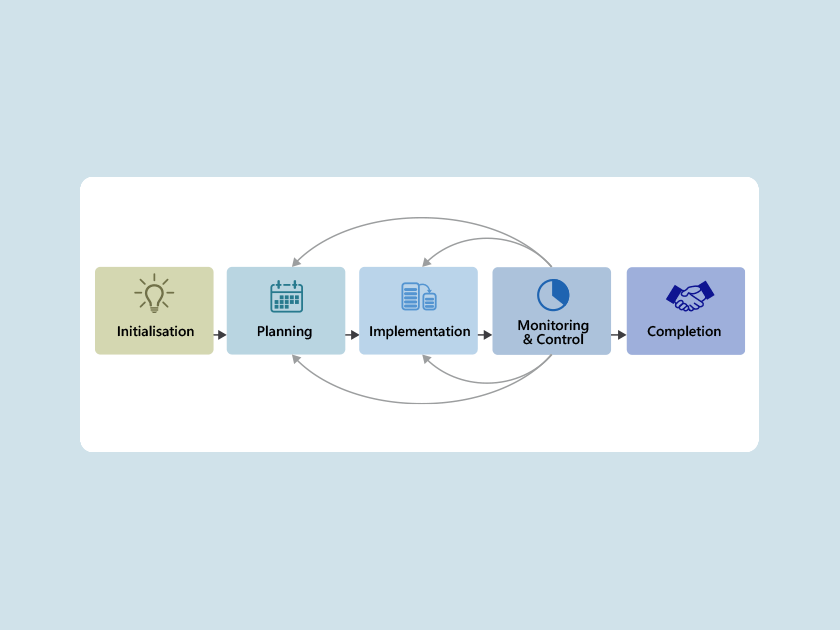
What is Project Management?
Project management provides structure, transparency, and planning certainty for complex projects. Using the right methods, clear processes, and centralized management, companies can balance time, budget, and quality, whether they use traditional, agile, or hybrid approaches.
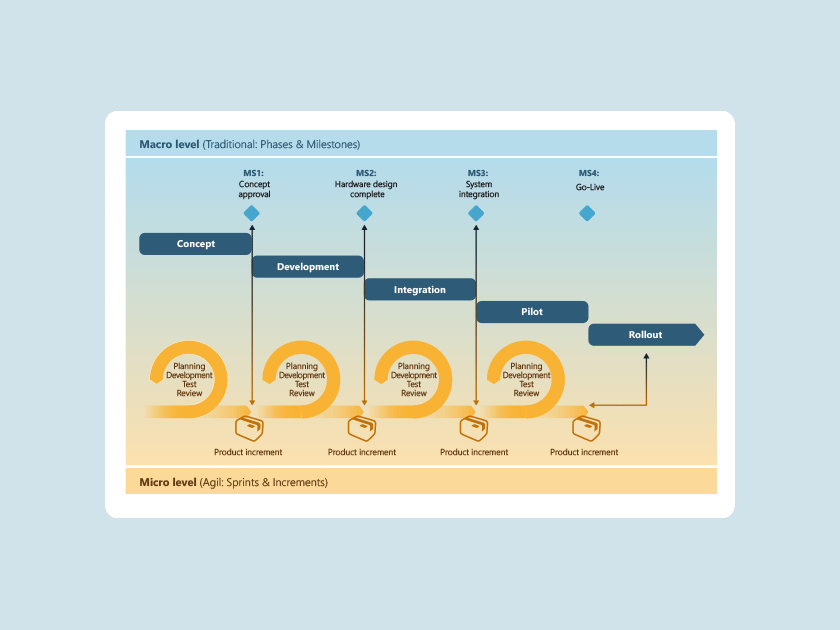
What is Hybrid Project Management?
Hybrid project management combines traditional planning with agile methods. This enables companies to maintain control over milestones, compliance and budgets while allowing teams to work flexibly and iteratively. With objectiF RPM, both approaches can be managed within a single, centralised platform.