

The EU AI Act (the European AI Regulation) is the world’s first comprehensive law regulating Artificial Intelligence, designed to ensure that AI systems are safe, transparent, and trustworthy. For systems engineering, this regulation means that compliance with legal mandates for AI components must now be treated as a permanent, verifiable system requirement throughout the entire product lifecycle. Core compliance mandates for high-risk systems will take effect on 2 December 2027.
Is Your System Development Ready for the EU AI Act?
Artificial Intelligence is fundamentally transforming engineering. The EU AI Act now establishes the necessary legal framework. Read this clear and straightforward guide to understand what the European AI Regulation means for your system development, and learn how to securely overcome compliance challenges in regulated industries.
Probabilistic Meets Deterministic Approach
Classical system development relies on pure determinism. According to programming logic, input A always results in output B. Safety analyses such as FMEA (Failure Mode and Effects Analysis) are specifically designed to evaluate these clear, logical failure chains. However, AI components operate probabilistically, meaning they work with probabilities. They learn from data and can react unpredictably in the field. The EU AI Act addresses exactly this issue by requiring companies to systematically control these unpredictable risks in a verifiable, systematic way through a combination of data governance, human oversight (human-in-the-loop), and transparent software architecture.
What Does the EU AI Act Mean for Systems Engineering?
Similar to functional safety and cybersecurity, compliance with the EU AI Act is now a permanent system requirement. The regulation applies to all companies that develop, import, or deploy AI systems within the European Union.
For systems engineering, this marks a fundamental paradigm shift. Compliance can no longer be treated as a retrospective, bureaucratic final report. Instead, it must be integrated into the development process as a core architectural driver. Since AI components operate probabilistically, systems engineers must anchor functional safety guards and mathematical plausibility checks into the system design from the conceptual phase onward. The regulation requires teams to expand the scope of their management to include not only the final source code, but also the composition, origin, and validation of the underlying training data, which now become configuration items subject to strict version control and change tracking.
The Risk Classification Framework of the EU AI Act
The EU AI Act follows a risk-based approach. The higher the potential risk an AI application poses to human safety or fundamental rights, the stricter the regulatory requirements. A commonly used simplified overview groups AI use cases into four risk levels; the Act also contains separate rules for general-purpose AI models:
| Description | Examples in Engineering | Regulatory Consequence | |
|---|---|---|---|
| Unacceptable Risk | Systems that pose a threat to people. | Social scoring, real-time biometric identification in public spaces. | Strictly prohibited |
| High Risk | Systems with significant impacts on health, safety, or fundamental rights. | AI in medical devices, autonomous control systems in mechanical engineering, critical infrastructure. | Strictly mandatory requirements (Establishment of risk management, traceability, etc.) |
| Limited Risk | Systems with lower hazard potential. | Chatbots, generative AI for text or image editing. | Minimal transparency duties (Users must know they are interacting with AI). |
| Minimal Risk | The vast majority of all AI applications. | AI-powered spam filters, video games. | No specific obligations |
Which Obligations Must Companies Implement for High-Risk Systems?
Anyone who brings a high-risk AI system to the European market must meet strict legal obligations. The framework requires irrefutable evidence that the system remains safe and controllable throughout its entire lifecycle. For development teams, this translates into specific process requirements.
Systematic Risk Management
Establishing a continuous process to identify and mitigate AI risks from concept to operation.
Strict Data Governance
Quality validation and cleaning of datasets to specifically prevent errors and model distortions (bias).
Technical Documentation
Providing detailed evidence of system conformity prior to market introduction (conformity assessment).
Automated Logging
Seamlessly recording system states throughout the entire operating period for retrospective troubleshooting.
Human Oversight
Designing the system so that it can be effectively monitored and shut down in an emergency by a human.
How to Build an Effective AI Governance Framework
AI governance simply means that your company maintains and steers control over the entire AI lifecycle. To ensure successful systems engineering, this governance can be structured into five distinct steps.
1. Create an AI inventory: Record all AI components used or developed within the company and classify them according to the risk tiers of the AI Act.
2. Harmonize processes: Integrate the mandates of the AI Act into your existing quality (e.g., ISO 9001, ISO 13485) and risk (e.g., FMEA) management systems.
3. Establish end-to-end traceability: Make sure your toolchain can consistently link requirements, databases, system architectures, risks, and test results without contradiction.
4. Continuous monitoring: Establish processes to monitor the behavior of the AI in real-world operations continuously and counteract discrepancies (data drift) immediately.
5. Anchor AI Literacy (Art. 4): Ensure that your engineering and compliance teams are continuously trained to ensure a sufficient level of AI literacy in accordance with Article 4.
Which Internal Roles Are Involved?
The EU AI Act cannot be implemented in isolation within a single department. To bring a High-risk system to market compliantly, various technical and organizational roles within the company must work hand in hand:
Requirements Engineers
They translate the legal requirements of the AI Act, such as mandates for data quality and transparency, into specific functional and non-functional system requirements.
System Architects
They are responsible for integrating the probabilistic AI component into the overall model, such as via SysML/UML, in a way that protects the system from malfunctions through architectural barriers and encapsulation.
Data Scientists & AI Developers
They ensure strict compliance with data governance. To minimize model distortions (bias) from the outset, they must seamlessly document training and validation data.
Test & QA Engineers
They develop new validation scenarios to test the AI’s behavior under unpredictable field conditions, ensuring a seamless link from test evidence back to requirements.
Compliance & Risk Managers
They steer the overall conformity assessment process, moderate AI-specific risk analyses (e.g., extended FMEAs), and maintain contact with Notified Bodies.
AI Officers
They steer the overarching AI governance, coordinate interdisciplinary collaboration between engineering and legal departments, and ensure compliance with AI literacy requirements (Art. 4).
Embracing Compliance as a Quality Attribute
The EU AI Act is not an innovation blocker. Rather, it provides clear guidance for developing safe systems. Those who view legal requirements as a core component of their system architecture from the beginning, rather than a retrospective documentation burden, secure a genuine competitive advantage.
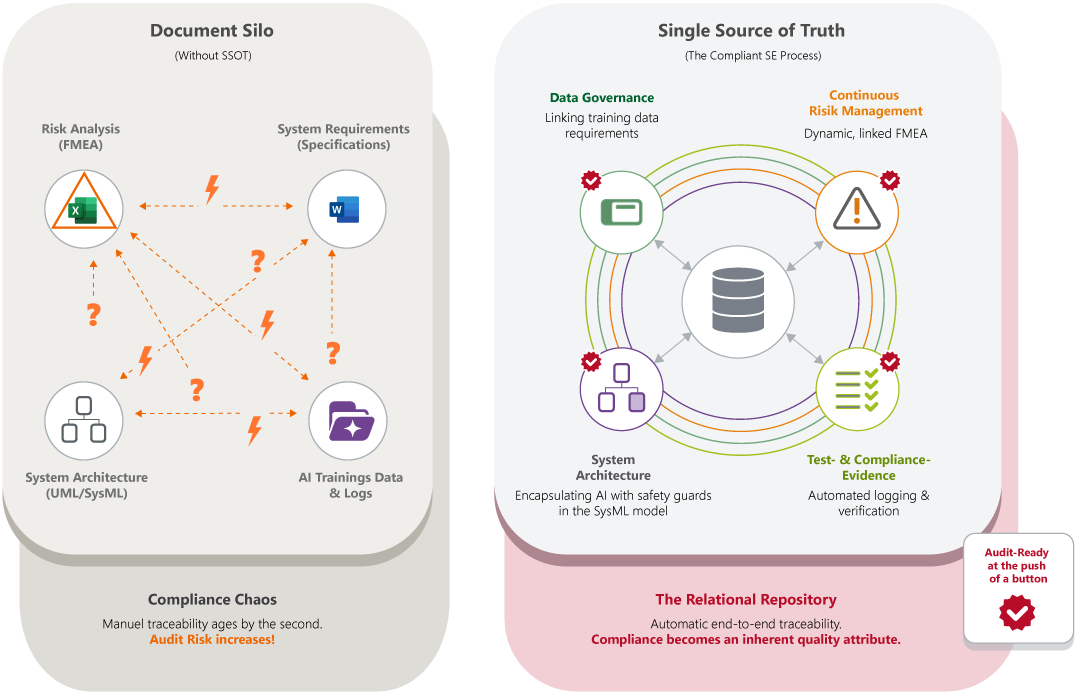
The key to stress-free compliance lies in breaking down information silos. When data requirements, system models, risks, and test cases are managed on a shared data foundation as a Single Source of Truth (SSOT) the verification demanded by law is generated automatically within the development process.
From Document Chaos to Audit-Ready AI Development
The EU AI Act is bound to fail if requirements are managed in Word, system models are managed in separate drawing tools, and risk analyses are managed in static Excel sheets. AI components constantly change due to new data, so isolated documentation quickly becomes obsolete. During an audit, manual setups collapse because ad hoc end-to-end traceability between data baselines, risk assessments, and test cases cannot be proven. Product recalls and sales halts are possible outcomes.
With objectiF RPM, companies can establish a genuine Single Source of Truth (SSOT). The platform naturally links system requirements, UML/SysML architecture models, AI-specific risks, and test cases on a shared data model. Modifications to the data baseline instantly flag all affected dependencies across the system, supporting the documentation, traceability and record-keeping obligations required under the AI Act.

Do You Want to Prepare Your Risk Management for the EU AI Act?
Discover in an exclusive live presentation how to master risk management using the relational repository of objectiF RPM.
FAQ
Do products from regulated industries fall under the EU AI Act?
AI systems used as safety components of certain regulated products, or themselves constituting such products, may qualify as high-risk where the conditions of Article 6 and Annex I are met.
What roles and responsibilities does the AI Regulation define?
The EU AI Act distinguishes between two types of entities: the provider, who develops the AI system and bears primary responsibility for its conformity, and the deployer, who uses the system professionally and is responsible for properly monitoring it during operation.
Is AI risk management legally mandated?
Yes. The EU AI Act strictly mandates that all AI systems classified as “high risk” establish and maintain a continuous, documented risk management system throughout the product’s entire lifecycle.
Do You Want to Know More?
Explore more knowledge base articles online or download one of our whitepapers.
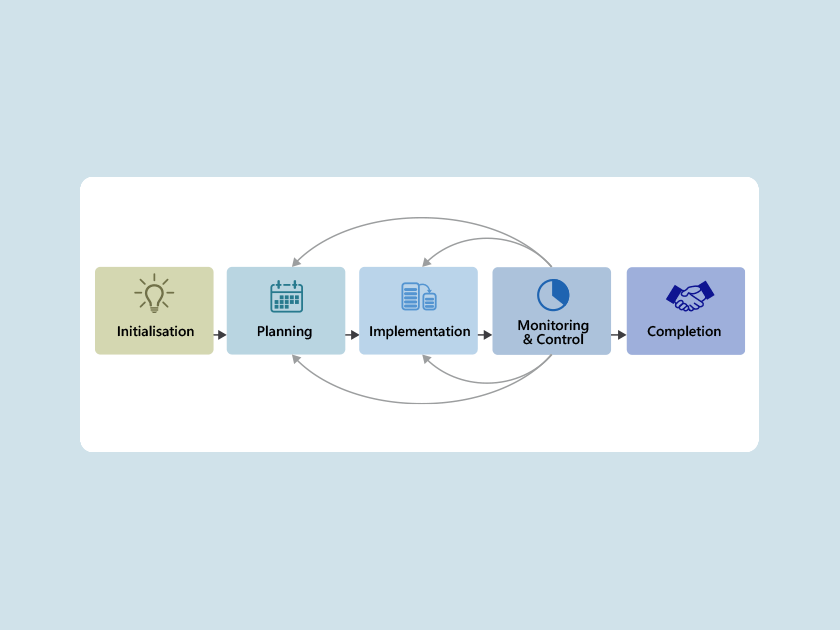
What is Project Management?
Project management provides structure, transparency, and planning certainty for complex projects. Using the right methods, clear processes, and centralized management, companies can balance time, budget, and quality, whether they use traditional, agile, or hybrid approaches.
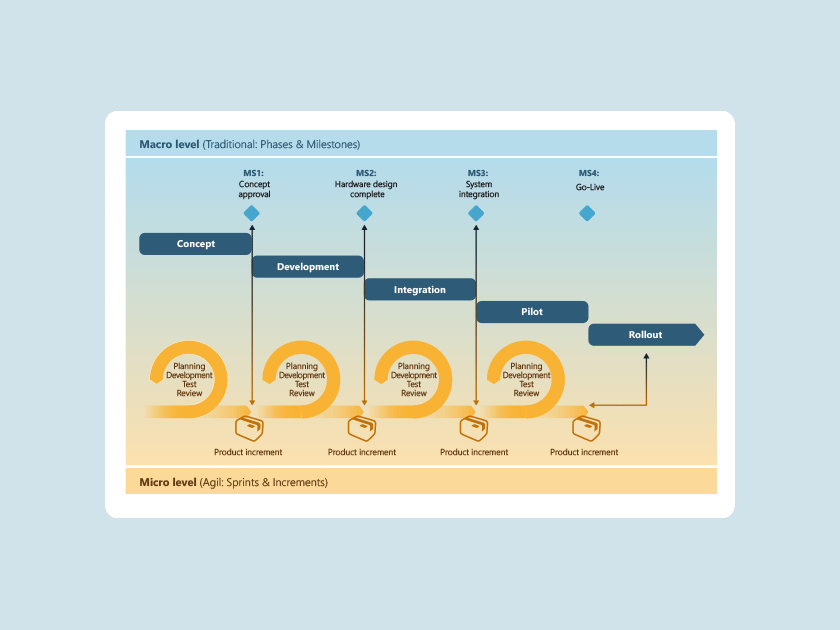
What is Hybrid Project Management?
Hybrid project management combines traditional planning with agile methods. This enables companies to maintain control over milestones, compliance and budgets while allowing teams to work flexibly and iteratively. With objectiF RPM, both approaches can be managed within a single, centralised platform.
Whitepaper – FMEA with objectiF RPM
Die Tool-Unterstützung für die Fehler-Möglichkeits- und Einfluss-Analyse.
objectiF RPM – Whitepaper
Increase your business agility. Get to know objectiF RPM in this whitepaper. From the needs of stakeholders to IT systems for successful business.