

A RACI matrix is a tool used to analyze and map out project responsibilities. The acronym RACI stands for four roles: Responsible (execution), Accountable (accountability), Consulted (consultation), and Informed (duty to inform). The matrix eliminates ambiguities regarding responsibilities and ensures that every project task has a clear “owner” to avoid duplication of effort.
“Power is duty, freedom is responsibility.”
– Marie von Ebner-Eschenbach
The Four RACI Roles in Detail
Each work package is assigned to exactly one level of responsibility in the matrix:

Responsible (R)
The person who carries out the task (“doer”).

Accountable (A)
The person who bears ultimate responsibility.
Important: The word “account” is implied here – this person must “take responsibility” for the outcome or “settle the bill.” There can be only one “A” per task.

Consulted (C)
Experts who are consulted before a decision is made (two-way communication).

Informed (I)
People who are informed about decisions that have been made (one-way communication).
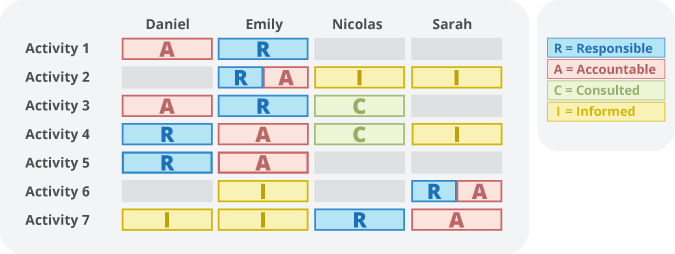
Example of a RACI matrix for clarifying roles and responsibilities. The matrix maps project activities (rows) to the people involved (columns) and clearly defines who is responsible for carrying out each activity (R), who is ultimately accountable (A), who is consulted for advice and input (C), and who is kept informed (I).
The History of LRC Becoming Modern RAM
The RACI matrix is not a new concept. In fact, it is the most well-known form of the Responsibility Assignment Matrix (RAM). It was developed in the 1950s under the name Linear Responsibility Chart (LRC) to structure complex industrial processes.
Why the RACI Matrix Complements the Work Breakdown Structure
The Work Breakdown Structure defines what needs to be done (work packages), while the RACI Matrix defines who is responsible for each package. In practice, the matrix’s rows are derived directly from the work packages in the WBS. The columns list the team members or departments responsible for each task. This linkage ensures that no task falls through the cracks.
7 Steps to Creating a RACI Matrix
- Select a presentation format: You can use an Excel template, PowerPoint, a whiteboard, or specialized project management software.
- Identify tasks: Transfer work packages directly from the work breakdown structure and list them in the rows.
- Define roles/participants: Enter the relevant project roles or team members for RACI in the columns.
- Create a draft matrix: Assign R, A, C, and I to the intersections.
- Review the draft and define responsibilities: Discuss the matrix with the team (this is important for acceptance) and designate someone to be responsible for maintaining the RACI matrix.
- Finalize the matrix: Resolve any conflicts (e.g., two “As”) and obtain approval for the matrix from all relevant stakeholders.
- Update: Adjust the matrix in the event of personnel changes or new tasks.
4 Golden Rules of a Successful Matrix
To prevent the RACI matrix from becoming a bureaucratic obstacle, project managers should follow these guidelines:
Rule 1: Only one “A“ per row
Responsibility cannot be shared because, ultimately, no one will feel accountable. Mathematically speaking, the following applies to every task in the matrix:
∑ Atask =1
This means that one person in charge must be designated, but there can only be one.
Rule 2: Appropriate amount of “C“ assignments
Having too many consultants can lead to “analysis paralysis” and delay the project.
Rule 3: Avoiding bottlenecks
Check the columns. Does a person have too many “R”s or “A”s? If so, they risk becoming a bottleneck.
Rule 4: Transparency
The matrix must be accessible to all parties involved at all times.
RACI and Agile – a Contradiction?
In agile project management, the RACI matrix is often rejected because the Scrum Guide states that the team as a whole is responsible for project outcomes.
Scrum Teams are typically composed of ten or fewer people. However, the more dependencies there are between teams and tasks and the more external stakeholders involved, the more difficult it becomes for everyone to be responsible for everything. This is why, even among agile practitioners, there are advocates of the RACI matrix who acknowledge the importance of having people who are “A and/or R.” Furthermore, at interfaces with external parties, such as line departments, management, and external suppliers, a RACI matrix clarifies expectations and serves as a valuable bridge.
Whether a RACI matrix is imposed top-down or developed collaboratively by the team is crucial, not only in an agile context.
Embodying Accountability within the System
Shelfware
The RACI matrix exists only as a spreadsheet and no one uses it.
In objectiF RPM, roles and permissions are stored directly within the system. Only users who have the necessary roles and permissions can perform specific workflow steps.
Information overload
Employees are flooded with emails, even though they are only being kept informed.
In objectiF RPM, users receive targeted notifications that correspond to their roles and permissions, and only those notifications.
Unclear division of responsibilities:
Although tasks are defined in the WBS, no one feels responsible for carrying them out.
Our tool links the WBS directly to resource management. Each work package is automatically assigned its RACI attributes, allowing every employee to see their personalized to-do list.

Bring Your RACI Matrix to Life
Integrate responsibilities directly into your project planning. See how objectiF RPM automatically links tasks from the WBS to the appropriate resources, streamlining information flow.
FAQ
Is it possible for one person to be R and A at the same time?
Yes, that’s often the case with smaller projects. One person completes the task (R) and is fully responsible for the result (A).
What do you do if you cannot find someone to be "A“?
This is a warning sign for risk management. Without an “A,” the task will fail in the event of a crisis. The project management team or sponsor must clearly assign responsibility here.
What happens when conflicts arise in RACI assignments?
Conflicts usually arise from “jockeying for authority” (too many A’s or R’s) or “shirking responsibility” (no A’s). The solution involves three steps:
- Analysis: Check if the task is too complex and needs to be divided.
- Facilitation: The project manager facilitates a meeting to clarify roles and resolve misunderstandings.
- Decision: If the team cannot reach an agreement, the next higher authority (sponsor or steering committee) must definitively assign the “A” role.
Note: It is better to have a conflict in the matrix than to have an unresolved conflict during project execution.
What is the difference between RACI, RASCI and DACI?
These are extensions. RASCI adds an “S” for support. DACI uses the terms Driver, Approver, Contributor, and Informed. For many projects, classic RACI remains a comparatively simple option.
Do You Want to Know More?
Explore more knowledge base articles online or download one of our whitepapers.
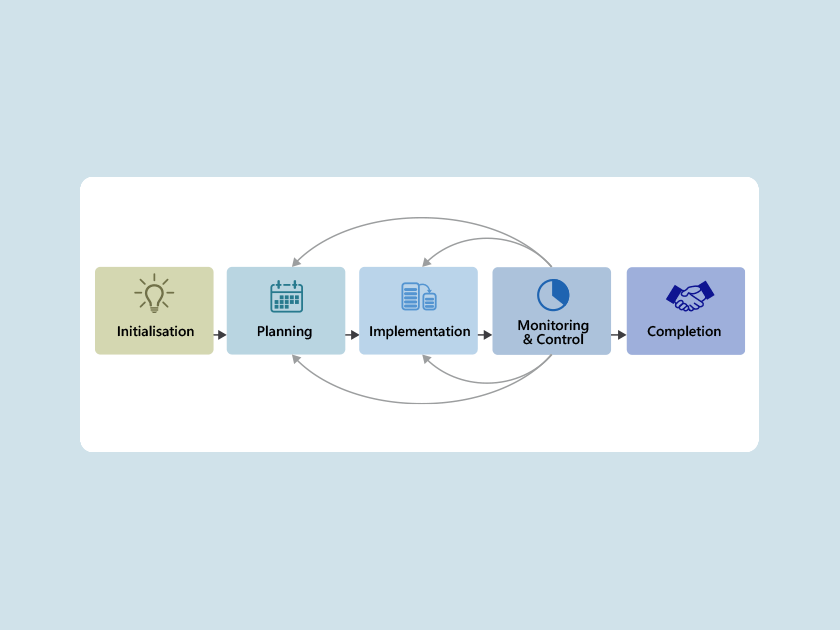
What is Project Management?
Project management provides structure, transparency, and planning certainty for complex projects. Using the right methods, clear processes, and centralized management, companies can balance time, budget, and quality, whether they use traditional, agile, or hybrid approaches.
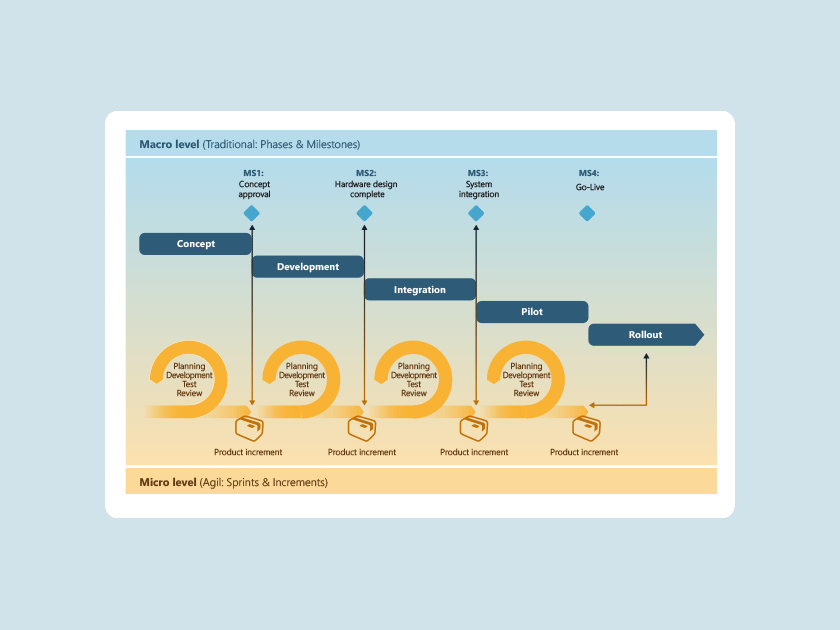
What is Hybrid Project Management?
Hybrid project management combines traditional planning with agile methods. This enables companies to maintain control over milestones, compliance and budgets while allowing teams to work flexibly and iteratively. With objectiF RPM, both approaches can be managed within a single, centralised platform.

objectiF RPM – Whitepaper
Increase your business agility. Get to know objectiF RPM in this whitepaper. From the needs of stakeholders to IT systems for successful business.
objectiF RM – Whitepaper
Requirements Engineering for Software and Systems. Read about benefits and options of objectiF RM in this whitepaper.