

A Project Structure Plan (PSP), known internationally as a Work Breakdown Structure (WBS), is a hierarchical representation of all the tasks and deliverables involved in a project. It breaks the project down into smaller, more manageable tasks and work packages. The PSP provides the basis for all subsequent planning, including schedules, costs and resources, and defines the project’s full scope. It answers the question: “What needs to be done?“
Structure and Presentation
A PSP must follow the 100-percent rule: it should contain exactly 100% of the work to be performed, neither more nor less. It is typically presented in graphical form as a tree structure or in tabular form as a list with indentations.
- Level 1: The overall project (root element)
- Level 2-n: Subprojects or subtasks
- Lowest level: Work packages, the smallest units that cannot be subdivided any further and can be assigned to a responsible person
Breaking down the structure to the work package level enables you to determine the responsibilities, costs, deadlines and deliverables for the tasks. This provides a basis for scheduling, processes, resources and cost planning.
Project Structure Plan
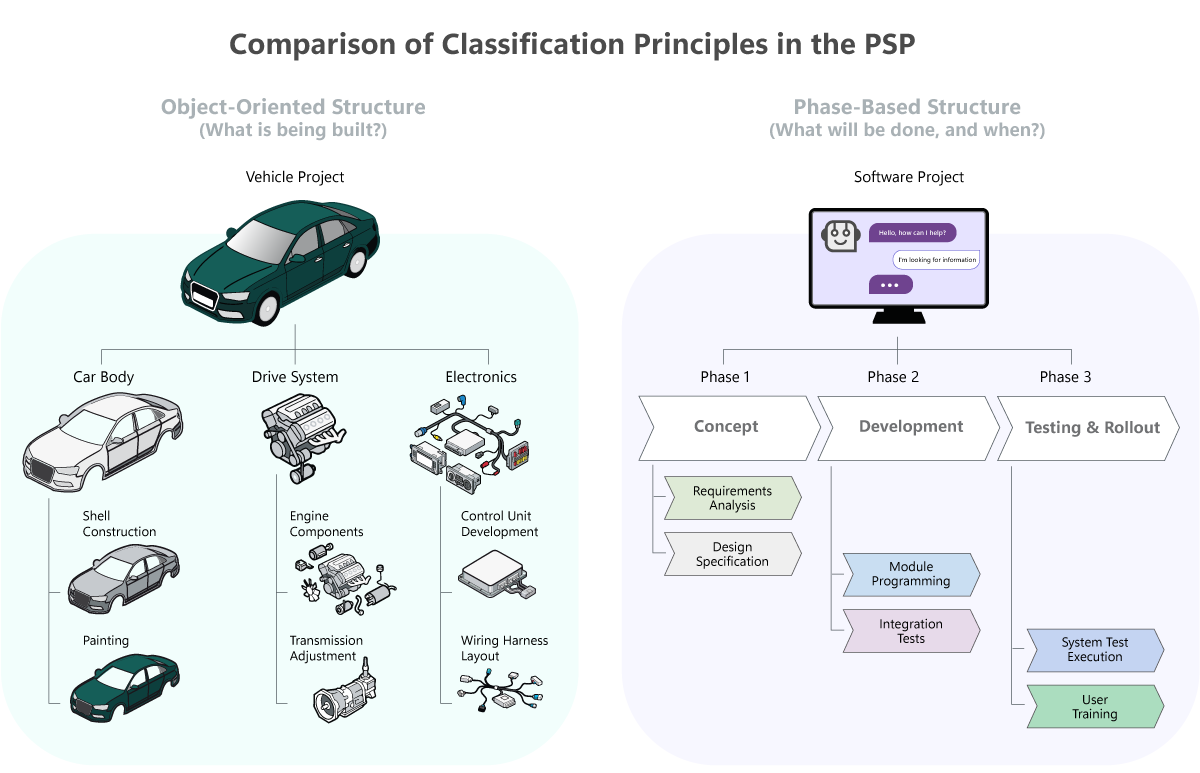
The type of project determines the structuring principle.
- Phase-oriented: Structured according to the timeline. This structure answers the question “In which phase is something done?” (concept, design, implementation, acceptance).
- Object-oriented: Organization based on product components, guided by the question, “What is being worked on?” (components, modules, or subsystems).
- Function-oriented: Organization into task packages based on the type of work corresponding to the question, “What is being done?” (e.g., planning, design/development, procurement, manufacturing/implementation, testing, documentation, and deployment). The function-oriented structure may also reflect areas of responsibility within the organization.
In practice, a hybrid form is often used to ensure the best possible overview.
Work Breakdown Structure vs. Project Schedule (Gantt Chart)
When planning a project, one principle always applies: Structure comes before schedule. A work breakdown structure (WBS) defines the project’s complete scope. Once the scope is established, work packages are scheduled in a Gantt chart, assigned durations, arranged in a logical sequence, and allocated to resources.
A common mistake is skipping the WBS and jumping straight into scheduling. Without the structural foundation provided by the WBS, important work packages can easily be overlooked. In other words, a project schedule without a solid WBS is often incomplete and can lead to unexpected work and delays as the project progresses.
The following table highlights the key differences:
| Work Breakdown Structure (WBS) | Project Schedule (Gantt Chart) | |
|---|---|---|
| Key question | What needs to be done? (Scope) | When will it be done? (Dates) |
| Focus | Hierarchical breakdown of the project scope | Chronological Order of Activities |
| Time factor | Contains no dates or durations | Defines duration, start date, and end date |
| Dependencies | Does not show logical dependencies (predecessors/successors) | Shows dependencies and the “critical path” |
| Visualization | Typically displayed as a hierarchical tree | Representation on a timeline (bar chart) |
| Foundation | Derived directly from the project objectives and requirements | Based on the PSP’s work packages |
Gantt Chart
The integration of structure and time. On the left is the hierarchical structure of the project structure plan, from which the timeline and milestones are derived in the Gantt chart on the right.

PSP in International Standards: PMBOK vs. PRINCE2
There are different perspectives on how a structural plan should be organized among various project management methods. To develop professional plans, it is helpful to understand these approaches.
PMBOK Guide (PMI): The Work Breakdown Structure (WBS)
The Project Management Institute (PMI) coined the term “work breakdown structure” (WBS). The 100-percent rule is central to this concept. The WBS must map out all the work required for the project. The goal is to define the project scope completely so that time and cost schedules can be derived from it later.
PRINCE2: The Product Breakdown Structure (PBS)
PRINCE2 uses a product-based planning approach. The first step is to identify all products (deliverables) before considering activities.
- Product Breakdown Structure (PBS): A hierarchical representation of all the project’s products.
- Product Flow Diagram (PFD): Defines the logical sequence in which these products are created.
The subtle difference: Product vs. activity.
While a traditional PSP often includes a mix of deliverables and activities, PRINCE2 requires planners to think strictly in terms of deliverables. Advantage: You focus on the benefits and the “what” rather than getting bogged down too early in the “how” (the activities).
How Do You Create a WBS?
There are various ways to develop a project structure plan. The method you choose significantly impacts how complete and logical the structure ultimately is.
Top-Down Approach (Deductive: “From the General to the Specific”)
This is the traditional approach. You start with the entire project at Level 1, then break it down into subtasks and work packages, step by step.
- When to use it: For projects that the team has experience with or that have a clear scope.
- Advantages: It ensures a logical structure and a strong focus on the overall goal.
- Risk: Details at the lowest level might be overlooked.
Bottom-Up Approach (Inductive: “From the Specific to the General“)
First, the team collects all possible tasks (e.g., through brainstorming on Post-its). Then, they organize them logically into a hierarchy.
- When to use it: This is useful for novel, innovative projects where the path to the goal is not yet clear.
- Advantages: Leverages the team’s full expertise and ensures a very high level of completeness at the work package level.
- Risk: The structure can become confusing, and there is a risk of redundancies.
Jojo Process (Counter Current Process)
In practice, this is the gold standard. It combines the best of both worlds.:
- Top-down: The project management team outlines the general structure of the first two levels.
- Bottom-up: Subject matter experts fill the lower levels with detailed work packages.
- Reconciliation (Jojo): The levels are cross-checked. Do all the collected packages fit into the structure? Is there a missing category at the top for tasks found below?
- Advantage: High-quality planning through dialogue between management and subject matter experts.
Who Creates the WBS and When?
Who
The project management team typically creates a PSP, often collaborating with the core team and subject matter experts. This promotes a shared understanding of the project scope.
When
The PSP is created during the planning phase, right after the project’s objectives and requirements have been defined in the requirements specification.
Maintenance
The PSP is a “living document.” It is updated whenever changes to the project scope are approved (change management). In day-to-day operations, the PSP serves as the basis for control. Completed work packages are marked, and new details are broken down further as needed.
What Are the Benefits of a WBS?
The PSP is an ideal project planning and management tool because it offers a wide range of benefits:
- Comprehensiveness: The project’s scope is presented in its entirety. Thanks to its systematic breakdown, nothing is overlooked.
- Transparency: All stakeholders can easily see how their contribution fits into the overall success.
- Basis for Calculation: Only the PSP allows for realistic resource, time, and cost estimates at the work package level.
- Risk Management: Complex, high-risk areas are identified early on, such as when a project branch has not yet been fully defined, and can be planned in greater detail.
From BWS to Project Success
Inconsistent or old plans:
Once a project has started, the WBS in PowerPoint or Excel is never modified again.
In objectiF RPM, the WBS serves as the foundation of the data. Each work package is automatically incorporated into capacity planning and budget control. The status of each work package is updated automatically.
Complexity overkill:
Large projects can make it easy to lose track of things in static lists.
objectiF RPM offers dynamic WBS views. You can switch between Gantt charts, lists, and Kanban boards with a single click, and the data will always stay in sync.

Structure is half the battle. Our tool takes care of the other half.
Are you tired of project structure plans that are static and outdated before the first work package begins? Transform your PSP into a dynamic control center. With objectiF RPM, you can link structure, time, and resources in one database.
FAQ
How detailed should a work package be?
It should be large enough to minimize administrative overhead, yet small enough to be accurately estimated and monitored. Often, a work package is one to two weeks in duration.
What is the difference between a Product Breakdown Structure (PBS) and a WBS?
The PBS (PRINCE2) focuses exclusively on the deliverables (products). The WBS (PMI), on the other hand, maps out all the work that must be done to achieve these deliverables. In practice, both are often combined in the WBS.
Is a work breakdown structure also useful in agile projects?
Yes, even though backlogs are often used in agile projects. A high-level work breakdown structure can help organize epics and topic areas strategically at the macro level (see also: hybrid project management).
Do You Want to Know More?
Explore more knowledge base articles online or download one of our whitepapers.
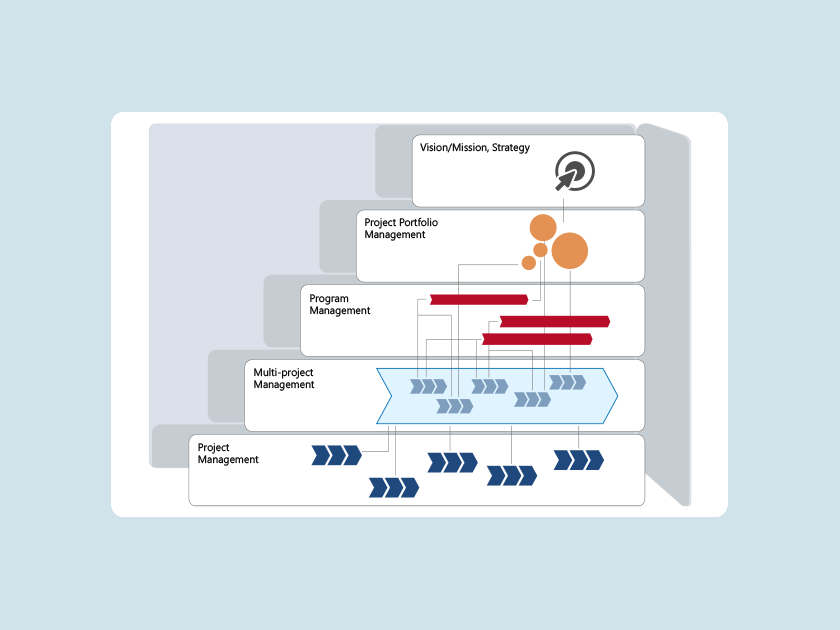
What is Project Portfolio Management?
Project Portfolio Management (PPM) Explained Simply: Learn how to manage and prioritize project portfolios, as well as implement corporate strategy.
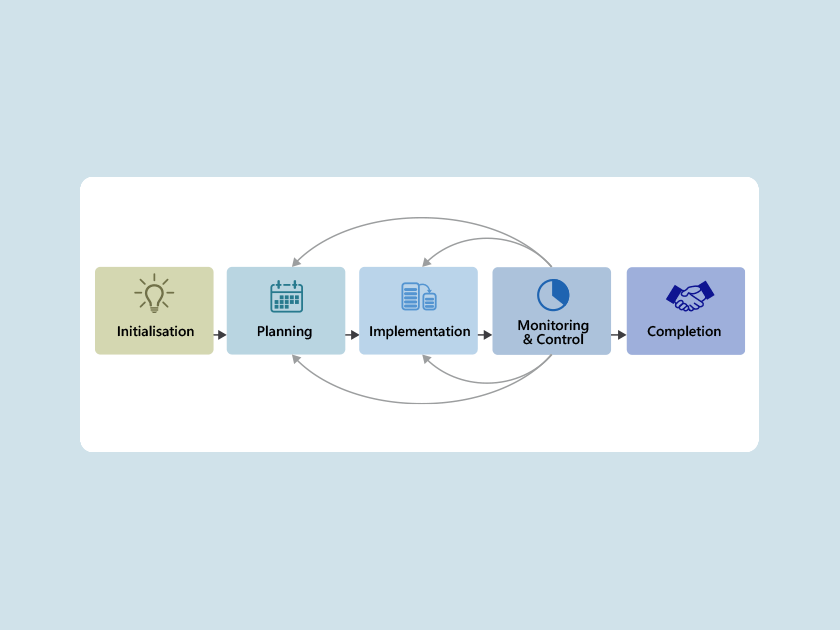
What is Project Management?
Project management provides structure, transparency, and planning certainty for complex projects. Using the right methods, clear processes, and centralized management, companies can balance time, budget, and quality, whether they use traditional, agile, or hybrid approaches.
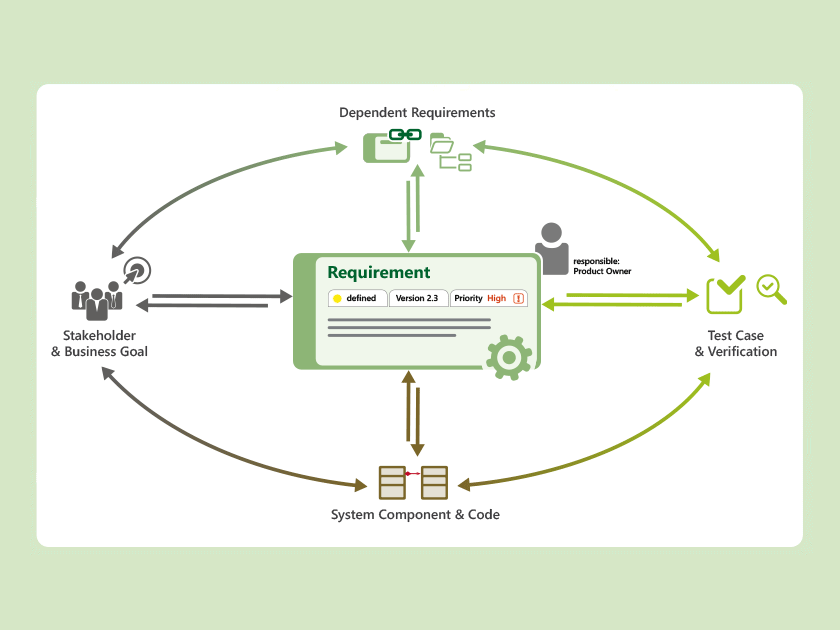
What is Requirements Management?
Requirements management (RM) involves managing requirements throughout their lifecycle. Learn how RM differs from requirements engineering and how tools can assist with the process.
objectiF RPM – Whitepaper
Increase your business agility. Get to know objectiF RPM in this whitepaper. From the needs of stakeholders to IT systems for successful business.
objectiF RM – Whitepaper
Requirements Engineering for Software and Systems. Read about benefits and options of objectiF RM in this whitepaper.