


They exist in nearly every major development project, whether the team is following the traditional V-model, an agile approach like Scrum, or a complex hybrid setup: requirements that were once painstakingly specified, documented, reviewed, and approved at great expense, but which have since lost their relevance.
They are “zombies”. They formally live on in documents and tools, but in terms of system architecture, they died a long time ago. Ignoring these “dead records” not only jeopardises the team’s efficiency, but in regulated industries, it also sets them up for disaster in the next audit.
How “Zombies” Infiltrate Project Reality
The emergence of unused or outdated requirements is not specific to any particular methodology. Every process model has its own unique weaknesses that can lead to the creation of “specification zombies”.
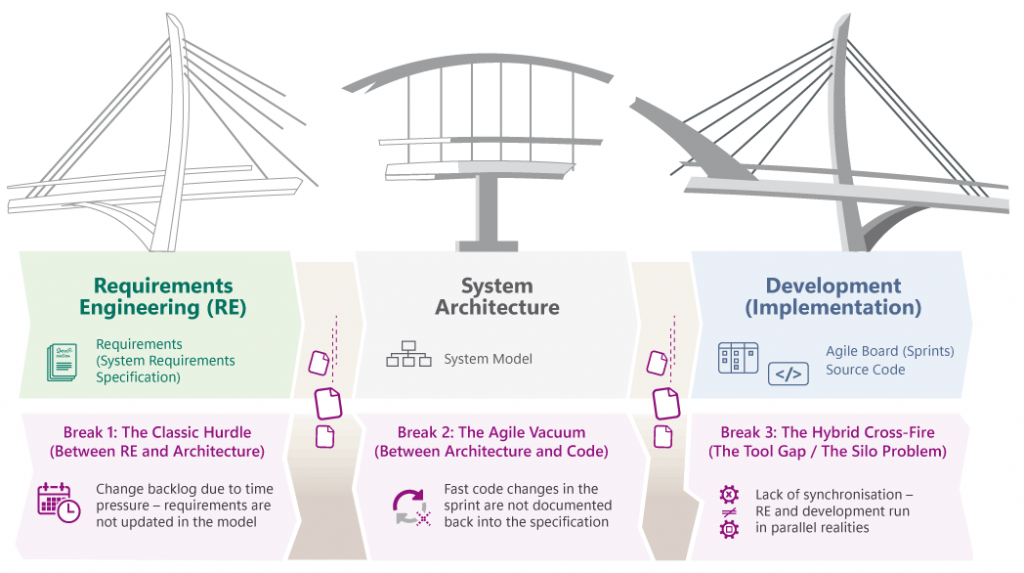
- The classic hurdle (the specification bottleneck): In sequential projects, a comprehensive requirements specification is created at the beginning. By the time the development or testing teams refer to it months later, however, the world has often moved on. Due to the massive cost and time pressures of the work, as well as the effort involved in formal change requests, the development team pragmatically works around the document. The specification becomes an abandoned shell.
- The agile vacuum (the documentation vacuum): In a sprint, things have to move fast. A feature is modified directly in the code, or a user story is spontaneously scrapped. In the heat of the moment, updating the specification is often forgotten. The original requirement is abandoned and turns into a zombie.
- The hybrid cross-fire (the tool gap): When the requirements engineering team is still thinking in terms of traditional milestones but the development team is already implementing agile sprints, the connection breaks down. The RE tool manages a state that no one in development remembers, and the sprints run off into a reality of their own.
Why Orphaned Data Jeopardizes the Project
One might argue: “What’s the harm in a requirement that’s just sitting in the system? At worst, it’ll just be ignored.” But that’s a fallacy. The hidden costs and risks of zombie requirements are enormous.
- They drive testing teams crazy. Test engineers often write and maintain test cases, either manually or automatically, for features that no longer exist or have been modified. This leads to erroneous test results (“false positives”) and wastes valuable resources.
- They hinder onboarding. New developers or architects try to understand the system based on the documentation. They encounter requirements that are nowhere to be found in the finished product. This causes massive confusion and tedious back-and-forth clarification loops.
- They put compliance at risk. Seamless traceability is mandatory, especially in regulated industries such as automotive, aerospace, and medical technology. A requirement in the specification that has no counterpart in the architecture or verified test case breaks the traceability chain, causing any audit to fail.
- They compromise AI analysis. Anyone using modern AI assistants to analyze requirements or generate test cases needs a reliable data source, or a Single Source of Truth (SSOT). If you “feed” the AI a specification half composed of “zombies,” it will optimize the system for the past and generate erroneous dependencies.
How Does objectiF RM Act as an Antidote?
To permanently end information chaos, cleaning up here and there is not enough. What’s needed is a system that inextricably links requirements, models, and implementation.
This is where objectiF RM comes in. As a holistic platform for requirements and systems engineering, objectiF RM ensures that goals, requirements, visual UML/SysML models, and test cases are all managed in one central location. Thanks to its defined workflows, the tool prevents zombie requirements from arising in the first place.
As soon as a requirement changes, all relevant elements are notified. No one has to conduct a detective-style search to determine whether a document is current. Additionally, the integrated AI functionality assists with verifying quality criteria.
Do You Have a Zombie Problem?
An orphaned requirement checklist is now available in our Download Center. With these 15 questions, you can determine if your project has any orphaned requirements.